
The idea that you must hold a university degree to teach English abroad stops many people before they even begin. It is one of the most persistent myths in the TEFL world, and it deserves a direct answer. The reality is more nuanced. Some countries do require a degree by law, while others place far greater weight on accredited TEFL or TESOL qualifications and practical classroom experience. This guide breaks down exactly where you stand, what qualifications matter most, and which routes are genuinely open to you, whether you hold a degree or not.
Table of Contents
- Understanding English teaching requirements around the world
- Do you need a degree to teach English in Spain, France, and Italy?
- Alternative qualifications for teaching English abroad
- Popular pathways: Routes for teachers without a university degree
- Frequently asked questions about teaching abroad without a degree
- Start your teaching journey with expert support
- Frequently asked questions
Key Takeaways
| Point | Details |
|---|---|
| Degrees not always required | Many countries and schools accept TEFL-certified teachers without a university degree. |
| TEFL is essential | An accredited TEFL or TESOL qualification opens doors for non-degree holders. |
| Options across Europe | Private institutions in Spain, France, and Italy hire teachers without degrees, especially with TEFL. |
| Step-by-step pathways | Securing international roles without a degree is possible with the right certifications and approach. |
Understanding English teaching requirements around the world
To understand whether you are eligible to teach English abroad, it is crucial to know the global landscape of requirements. The rules vary enormously from one country to the next, and even within countries, public and private sectors often operate under different standards.
As a starting point, TEFL requirements by country confirm that some countries require a degree by law, but others are considerably more flexible with qualifications. Countries such as South Korea, China, and the UAE typically enforce degree requirements at the visa stage, meaning no degree means no work visa. However, this is far from a universal rule.
Spain, France, and Italy, three of the most popular destinations for aspiring English teachers, each offer routes that do not always demand a university degree. Understanding the steps to teaching English abroad is the best way to map out your personal eligibility before you apply anywhere.
Here is a quick overview of how degree requirements break down globally:
- Countries with strict degree requirements: South Korea, China, UAE, Japan (for most visa categories)
- Countries with flexible requirements: Spain, Italy, Mexico, Czech Republic, and parts of Latin America
- Programmes requiring degrees: JET (Japan), EPIK (South Korea), TAPIF (France) for public placements
- Private language schools: Often prioritise accredited TEFL/TESOL over formal degrees in many regions
“The private language school sector across Europe and Latin America is one of the most accessible entry points for TEFL-qualified teachers who do not hold a university degree.”
Do you need a degree to teach English in Spain, France, and Italy?
Now, let us focus more closely on three popular European destinations and see how their requirements compare for non-degree holders.
The picture across Spain, France, and Italy is genuinely encouraging for those without a degree, particularly in the private sector. Private language schools in Spain and Italy often hire teachers without degrees, focusing instead on TEFL/TESOL qualifications. This is a significant distinction that many aspiring teachers overlook when researching their options. For a fuller picture, the teaching abroad guide covers country-specific advice in detail.
| Country | Public sector | Private schools | Degree required? |
|---|---|---|---|
| Spain | Degree usually required (auxiliares) | TEFL/TESOL accepted | Not always |
| France | Degree required (TAPIF) | Flexible for private/summer schools | Not always |
| Italy | Limited public routes | Open to accredited TEFL holders | Rarely |
Key insight: Italy is arguably the most accessible of the three for non-graduates. Private schools and summer language camps actively recruit TEFL-qualified teachers, and the demand for native or near-native English speakers remains strong year-round.
In Spain, the auxiliares de conversación programme does require a degree, but this is just one route. Hundreds of private academies across Madrid, Barcelona, and Seville hire based on TEFL certification and interview performance. France follows a similar pattern, with TAPIF requiring a degree but private and summer schools operating with far more flexibility.
Alternative qualifications for teaching English abroad
If you do not have a university degree, there are respected alternatives that most schools and employers now look for. In fact, for many private employers, an accredited TEFL or TESOL qualification carries more practical weight than a degree in an unrelated subject.
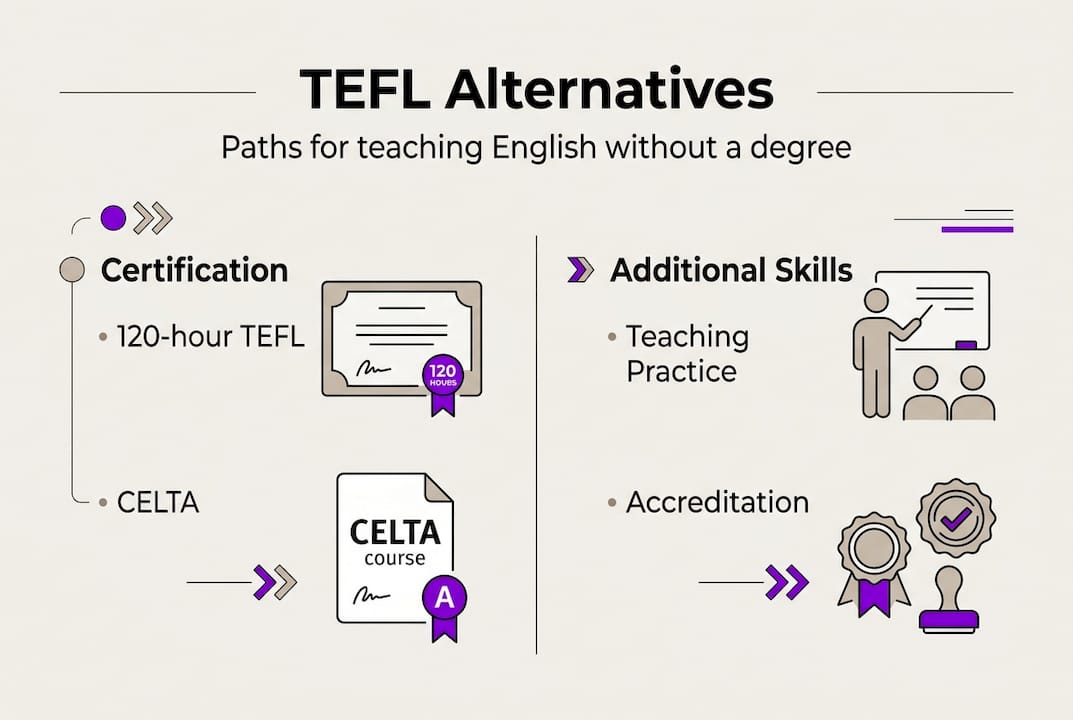
A 120-hour TEFL certificate is the most widely accepted minimum qualification for entry-level English teaching posts worldwide. Courses that include observed teaching practice and are accredited by a recognised body, such as Trinity College London, carry the most credibility with employers globally.
Here is how the main qualifications compare:
| Qualification | Hours | Teaching practice | Global recognition |
|---|---|---|---|
| Standard TEFL | 120+ | Sometimes included | Widely accepted |
| Trinity CertTESOL | 130+ | Always included | Highly recognised |
| CELTA | 120+ | Always included | Highly recognised |
For those exploring their certification to teach English abroad, the key factors to prioritise are accreditation, teaching practice hours, and international recognition. An ESL teaching qualification from Trinity College London, for example, is respected by employers across Europe, Asia, and the Americas.
If you plan to teach online, it is worth checking the specific online teaching requirements for your target platforms, as these vary. Many online platforms accept TEFL-qualified applicants without a degree, making this a particularly accessible route.
Key features to look for in a quality TEFL course:
- Minimum 120 hours of study
- Observed and assessed teaching practice with real learners
- Accreditation from a recognised body (Trinity College London, for example)
- Internationally recognised certificate upon completion
- Ongoing support and job placement assistance
Pro Tip: Avoid courses that offer a certificate with no teaching practice component. Employers, particularly in Europe, can spot the difference immediately, and it will affect your interview success rate.
Popular pathways: Routes for teachers without a university degree
Ready to take the leap? Here is how you can start teaching English abroad, even if you have not completed a university degree.
Many language schools worldwide focus on accredited TEFL, teaching practice, and language ability over formal degrees. This means your route into the classroom is very much achievable with the right preparation. Reviewing your TEFL career steps early will help you plan efficiently and avoid common mistakes.
Here is a practical, step-by-step route for non-graduates:
- Complete an accredited TEFL or TESOL course with a minimum of 120 hours and observed teaching practice. Trinity College London accredited programmes are particularly well regarded.
- Research your target country and identify whether private schools, summer camps, or language academies are the most accessible entry points for non-graduates.
- Tailor your CV to highlight your TEFL qualification, any language skills you hold, and relevant experience working with people or in education.
- Apply directly to private language schools rather than government-run programmes, which are more likely to require a degree.
- Network actively through TEFL communities, social media groups, and alumni networks. Many teaching jobs are filled through personal recommendations.
- Prepare for interviews by demonstrating classroom confidence, cultural adaptability, and a genuine enthusiasm for language learning.
Pro Tip: If you speak even basic Spanish, French, or Italian, mention it prominently in your application. Schools in these countries value teachers who show commitment to the local culture, and it sets you apart from candidates who have made no effort to engage with the language.
Direct outreach to schools is often more effective than job boards alone. A well-written speculative email, sent to a targeted list of private academies in your chosen city, can generate interviews that never appear on public listings.
Frequently asked questions about teaching abroad without a degree
Let us address some of the most common concerns aspiring teachers raise when considering this path.
Can you teach English abroad without a degree? Yes, in many countries and contexts. Private language schools across Spain, Italy, and much of Latin America regularly hire TEFL-qualified teachers without a university degree. The key is targeting the right employers and holding a credible, accredited qualification.
Is it better to take an in-person or online TEFL course? Both have genuine merit. In-person courses offer structured teaching practice and immediate feedback, which many employers value highly. Online courses offer flexibility and are ideal if you are working or studying while you train. The most important factor is accreditation, not delivery format.
What if my first language is not English? Non-native English speakers can and do teach English abroad successfully. Many schools actively seek teachers who understand the language learning process from the inside. A strong command of English and an accredited TEFL qualification are the primary requirements.
Is online teaching an option for non-degree holders? Absolutely. Teaching English online is open to non-graduates, provided they hold accredited TEFL certification. Many platforms have removed degree requirements entirely, making this one of the most accessible routes into English teaching.
Are jobs for non-graduates well-paid or secure? Salaries vary by country and employer, but accredited TEFL and strong classroom skills can significantly improve your earning potential. Experience builds quickly, and many teachers without degrees progress to senior roles, teacher training positions, or school management over time.
Start your teaching journey with expert support
If you are ready to turn knowledge into action, discover how tailored support and industry-recognised training can open international doors for you.
At EBC TEFL, we work with aspiring teachers across the globe, connecting them with international teaching certification that is recognised by employers in Spain, France, Italy, and well beyond. Our programmes are accredited by Trinity College London, one of the most respected names in language education worldwide. Whether you are exploring a TEFL introduction or ready to commit to a full qualification, we offer flexible training routes, lifetime job placement support, and one-year study and work abroad programmes designed to give you a genuine head start. Speak to our team today and book a consultation to find the right path for your goals.
Frequently asked questions
Can I teach English in Spain, France, or Italy without a degree?
Yes, private schools in Spain and Italy hire non-degree holders regularly, and similar opportunities exist in France through private language schools and summer programmes. An accredited TEFL qualification is the key requirement.
Is online teaching possible if I don’t have a university degree?
Most online English teaching platforms accept TEFL-qualified applicants without a university degree, as confirmed by online teaching certification guidance. Requirements vary by platform, so always check individual criteria before applying.
Which TEFL certification is best for non-degree holders?
Choose an accredited, internationally recognised TEFL with a minimum of 120 hours and teaching practice. Trinity College London accredited qualifications, such as the CertTESOL, are among the most respected options available.
Will I earn less without a degree?
Some employers may offer lower starting salaries to non-graduates, but salary ranges depend on qualification and experience rather than degree status alone. Strong TEFL credentials and classroom confidence can close the gap considerably.