
Choosing the right TEFL certification can feel like the key that unlocks your future in international education. For aspiring teachers drawn to vibrant classrooms in Spain, France, or Italy, finding an accredited programme is the first step towards building both professional expertise and cultural understanding. Discover how internationally recognised TEFL certificates provide practical training and global support, setting the foundation for a rewarding career and immersive experiences in some of Europe’s most inspiring destinations.
Table of Contents
- Step 1: Explore Accredited TEFL Certification Options
- Step 2: Apply for Trinity College London Courses
- Step 3: Complete Hands-On Teacher Training
- Step 4: Secure Job Placement with Global Support
- Step 5: Join a One-Year Study or Work Abroad Programme
- Step 6: Verify Cultural and Professional Readiness
Quick Summary
| Key Point | Explanation |
|---|---|
| 1. Choose accredited TEFL programmes | Selecting a recognised TEFL certification affects your teaching opportunities globally, so research valid options thoroughly. |
| 2. Apply strategically for courses | Follow the necessary steps for applying to Trinity College London, ensuring you meet all requirements and deadlines. |
| 3. Gain hands-on teaching experience | Participate in practical training, focusing on classroom observation and lesson planning to enhance your teaching efficacy. |
| 4. Leverage job placement support | Utilize the resources offered by certification providers to secure teaching positions internationally after completing your qualification. |
| 5. Assess cultural readiness pre-departure | Evaluate your adaptability and intercultural skills, reinforcing your ability to thrive in diverse teaching environments abroad. |
Step 1: Explore accredited TEFL certification options
Teaching English abroad starts with selecting the right certification programme. Your journey begins by understanding the landscape of accredited TEFL courses, which will determine your future teaching opportunities worldwide.
When exploring certification options, consider these crucial factors:
- Internationally recognised accreditation
- Practical teaching experience components
- Course duration and flexibility
- Global job placement support
- Specialisation opportunities
The most reputable TEFL programmes offer comprehensive training that goes beyond theoretical learning. They provide practical classroom experience, comprehensive pedagogical techniques, and robust support networks. Trinity College London certifications, for instance, represent gold-standard credentials that employers worldwide recognise.
To help you compare leading TEFL certification bodies, see the table below:
| Certification Body | Recognition Level | Practical Training Component |
|---|---|---|
| Trinity College London | Globally recognised | Extensive classroom teaching practice |
| Cambridge Assessment English | International standard | Supervised practicum and observations |
| CELTA | Widely accepted | Real student teaching experience |
| IATQuO | European recognition | Focus on hands-on training sessions |
Professional TEFL certification is your passport to global teaching opportunities.
Your chosen programme should offer structured learning pathways that equip you with real-world teaching skills. Look for courses that combine theoretical knowledge with practical teaching practice, ensuring you’re prepared for classroom challenges.
Expert recommendation: Research multiple accreditation options and compare their international recognition before making your final selection.
Step 2: Apply for Trinity College London courses
Now that you understand accredited TEFL certification options, it’s time to navigate the application process for Trinity College London courses. Your goal is to secure a professionally recognised teaching qualification that opens global career opportunities.
Applying for Trinity College London certification involves several strategic steps:
- Review programme requirements thoroughly
- Gather necessary documentation
- Complete pre-admission interview
- Submit formal application
- Pay course registration fees
Trinity College London offers multiple course formats designed to accommodate different learning preferences. Flexible learning options include full-time, part-time, online, and blended programmes. These versatile delivery methods ensure that regardless of your current commitments, you can pursue your teaching certification.
Professional teaching qualifications are investments in your global career mobility.
The application process typically requires demonstrating English language proficiency, providing academic transcripts, and participating in a pre-admission interview. Each centre might have slightly different specific requirements, so direct communication with your chosen provider is crucial.
Expert recommendation: Contact multiple Trinity College London course providers to compare programme structures and find the most suitable pathway for your teaching aspirations.
Step 3: Complete hands-on teacher training
The cornerstone of your TEFL journey is acquiring practical classroom skills through comprehensive teaching practicum, which transforms theoretical knowledge into genuine teaching expertise.
Your hands-on teacher training will typically involve several critical components:
- Classroom observation techniques
- Lesson planning and design
- Microteaching sessions
- Live student interaction
- Mentor feedback and coaching
- Reflective teaching practice
Successful teacher training programmes integrate theoretical learning with real-world teaching scenarios. Practical experience matters most in developing confidence and competence as an English language instructor. During your training, you will progressively build skills through structured teaching opportunities, moving from observational learning to independent classroom management.
Effective teacher training bridges the gap between academic knowledge and classroom performance.
Each teaching practice session provides an opportunity to apply pedagogical techniques, manage classroom dynamics, and receive constructive feedback from experienced professionals. These immersive experiences are designed to prepare you for diverse teaching environments across different cultural contexts.

Expert recommendation: Approach each teaching practice session as a valuable learning opportunity, focusing on continuous improvement and professional growth.
Step 4: Secure job placement with global support
The final stage of your TEFL journey transforms your certification into a meaningful international teaching career. Global job placement support becomes your gateway to exciting opportunities across continents.
Successful job placement involves strategic preparation and leveraging professional networks:
- Professional CV and resume development
- Interview preparation techniques
- Cultural adaptation strategies
- Understanding international recruitment processes
- Networking with language schools
- Managing visa and work permit requirements
Your certification provider typically offers comprehensive support mechanisms designed to connect qualified teachers with reputable educational institutions. Targeted job placement assistance helps match your skills, preferences, and qualifications with suitable teaching roles across different global markets.
Your TEFL certification is more than a qualification – it’s a passport to international opportunities.
Most programmes provide lifetime job placement support, which means continuous assistance even after you complete your initial certification. This includes access to job boards, recruitment networks, and ongoing professional development resources that extend well beyond your initial training period.
Expert recommendation: Remain flexible and open-minded about potential teaching locations, as unexpected opportunities often lead to the most transformative professional experiences.
Step 5: Join a one-year study or work abroad programme
Embark on an extraordinary international journey by exploring comprehensive TESOL study programmes that combine professional training with cultural immersion.
Your one-year programme will typically encompass multiple dynamic components:
- Language and cultural training
- Professional teaching certification
- Practical classroom experience
- Part-time work opportunities
- Visa and residency support
- Professional networking
International programmes offer structured pathways for aspiring teachers to transform their careers. These integrated experiences provide more than just a qualification – they deliver a holistic approach to professional development, combining academic learning with real-world teaching opportunities across different global contexts.
A one-year abroad programme is an investment in your personal and professional transformation.
Successful participants benefit from comprehensive support systems that help navigate complex international employment landscapes. These programmes are meticulously designed to provide seamless transitions between academic learning, professional certification, and practical teaching experiences.
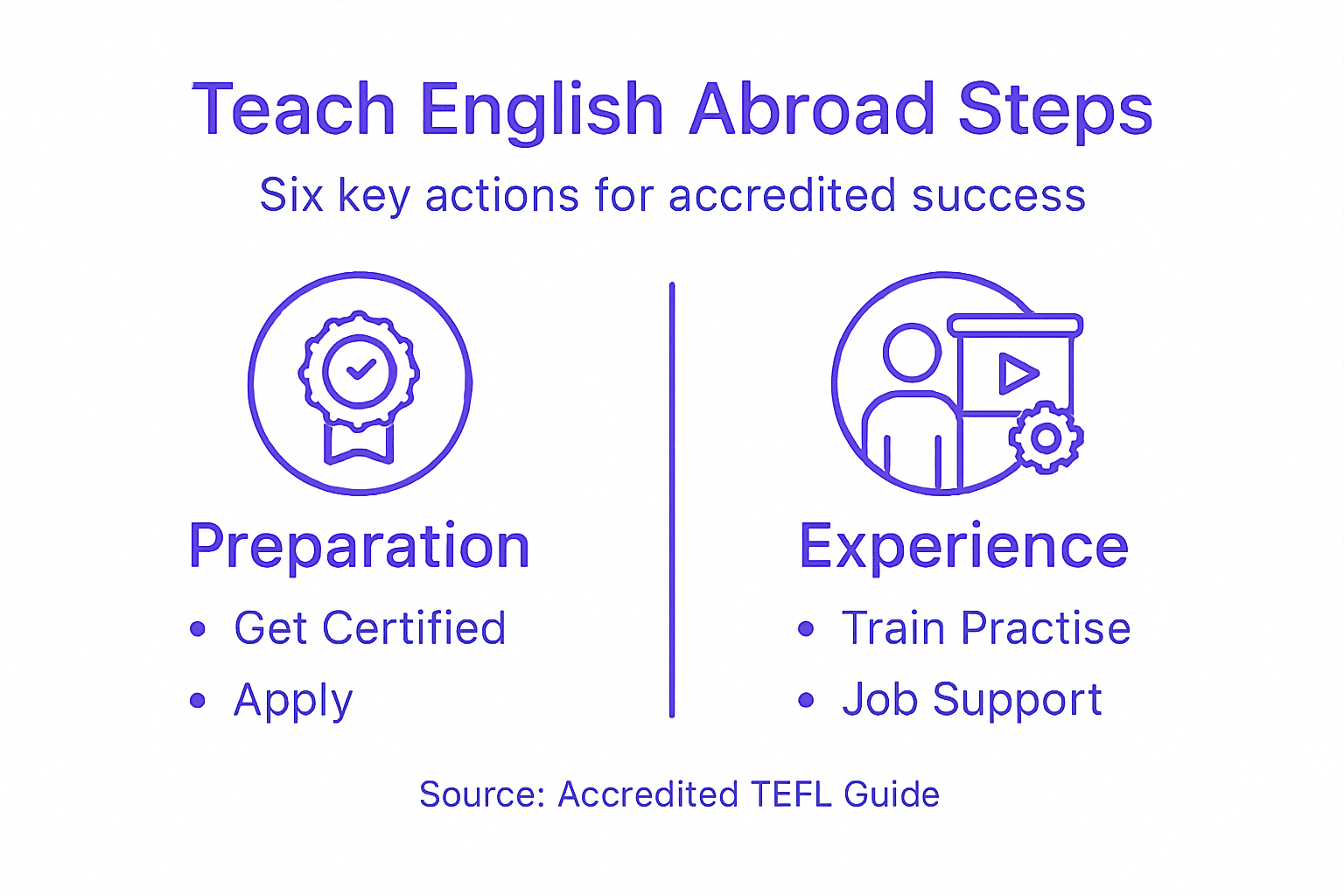
Here is a summary of how one-year study or work abroad programmes support your career development:
| Programme Feature | Benefit to Participants | Career Impact |
|---|---|---|
| Cultural immersion | Builds local language skills | Increases adaptability |
| Teaching certification | Meets global employment criteria | Expands job options |
| Professional networking | Creates international contacts | Enhances opportunities |
| Ongoing support | Assists with logistics and visas | Reduces relocation risk |
Expert recommendation: Approach your study abroad programme with an open mind and a commitment to continuous learning, as unexpected experiences often become your most valuable professional assets.
Step 6: Verify cultural and professional readiness
Before embarking on your international teaching journey, you must develop a comprehensive understanding of your personal and professional capabilities. Cultural competence is just as crucial as your teaching qualifications.
Prepare for your international experience by assessing these key dimensions:
- Language proficiency assessment
- Cross-cultural communication skills
- Personal adaptability
- Emotional resilience
- Professional flexibility
- Basic understanding of local customs
Successful international educators recognise that teaching abroad requires more than technical expertise. Professional readiness encompasses psychological preparedness, intercultural sensitivity, and the ability to navigate unfamiliar professional environments with confidence and respect.
Cultural adaptability transforms challenges into opportunities for personal growth.
Each potential teaching destination presents unique contextual nuances. Understanding these subtleties involves deep research, self-reflection, and a willingness to challenge your existing perspectives. Your preparation should focus not just on teaching techniques, but on developing genuine cultural empathy.
Expert recommendation: Engage with cultural learning resources, connect with experienced international teachers, and maintain an open, curious mindset about your upcoming professional adventure.
Unlock Your Global Teaching Career with EBC TEFL
If you have been wondering how to teach English abroad and are seeking an accredited pathway that guarantees practical training and real worldwide job opportunities, EBC TEFL is your perfect partner. We specifically address the challenges highlighted in your journey such as recognising credible Trinity College London courses, gaining hands-on teacher training, and securing ongoing job placement support that lasts a lifetime. With our specialised Trinity CertTESOL and tailored pathways including Business English and Online Teaching, you gain qualifications respected by employers from Spain to Asia.
Start your adventure with confidence by exploring our comprehensive 1-year study and work abroad programmes in Spain, France, and Italy. These programmes combine culturally immersive language study with professional teacher certification, visa assistance, and part-time teaching opportunities. Take advantage of our free consultations and personalised application support to receive expert guidance from the first step to job placement and beyond. Act now to transform your teaching ambitions into a rewarding international career with EBC TEFL. Book your free consultation today at EBC TEFL.
Frequently Asked Questions
What is an accredited TEFL certification programme?
Accredited TEFL certification programmes are recognised courses that meet international standards for teaching English as a foreign language. To secure a credible qualification, choose a programme that has been accredited by a reputable body, ensuring that you can teach abroad with confidence.
How can I apply for a Trinity College London TEFL course?
To apply for a Trinity College London TEFL course, review the specific programme requirements, gather necessary documentation, and complete a pre-admission interview. Submit your formal application and pay the course registration fees to secure your place.
What does hands-on teacher training involve in a TEFL course?
Hands-on teacher training in a TEFL course includes classroom observations, lesson planning, microteaching sessions, and live student interactions. Engage actively in these practical components to develop your teaching skills and gain valuable feedback from mentors.
How does global job placement support work for TEFL graduates?
Global job placement support for TEFL graduates encompasses assistance with CV development, interview preparation, and connecting with language schools worldwide. Take advantage of these resources to increase your chances of securing a teaching position abroad.
What should I consider before embarking on an international teaching journey?
Before teaching abroad, assess your cultural competence, language proficiency, and adaptability. Prepare yourself by conducting thorough research on the destination’s customs and engaging with resources to enhance your cross-cultural communication skills.
How can I maximise my experience during a one-year study or work abroad programme?
To maximise your experience during a one-year study or work abroad programme, immerse yourself in the local culture, actively participate in professional networking events, and seek out practical teaching opportunities. This will provide you with invaluable skills and connections that enhance your career development.