
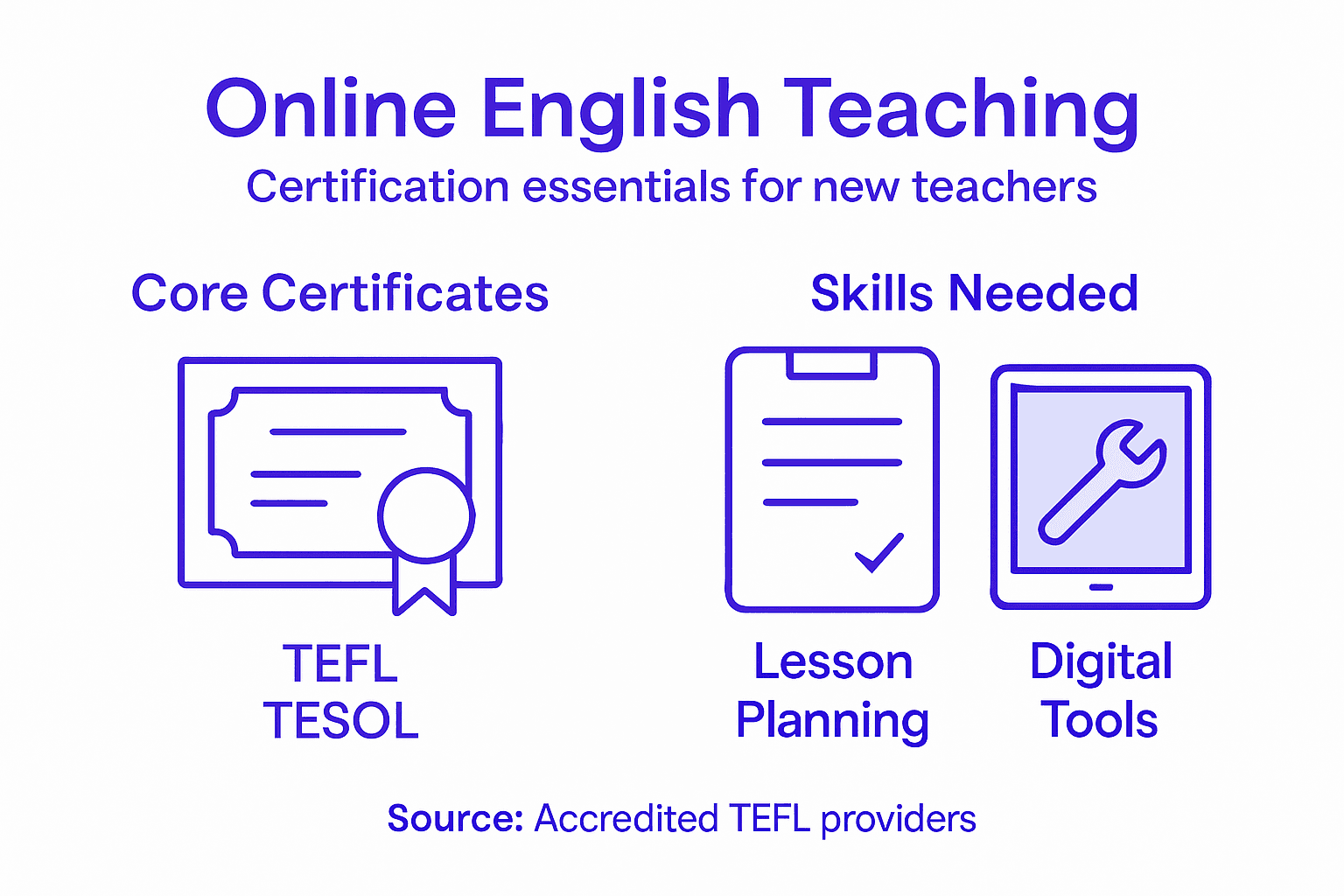
Teaching English online opens doors far beyond the four walls of a classroom. For graduates eager to work abroad, the freedom to reach learners everywhere means true professional flexibility. The journey starts with earning an accredited TEFL certification—giving you the confidence and credentials valued by employers and students alike. You’ll discover exactly what online teaching involves, how certification shapes your career, and why mastering digital tools is essential for teachers aiming to make a global impact.
Table of Contents
- Teaching English Online Explained Clearly
- Types of Accredited TEFL Qualifications
- Essential Skills and Certification Process
- Visa Options for Europe and Globally
- Common Pitfalls and How to Avoid Them
Key Takeaways
| Point | Details |
|---|---|
| Flexibility of Online Teaching | Teach English from anywhere, allowing for a balance between work and personal commitments. |
| Importance of Certification | Accredited qualifications are essential for credibility; they enhance employability and higher wages. |
| Technical Proficiency Required | Successful online teachers must manage digital tools and maintain effective communication through screens. |
| Preparation and Professional Boundaries | Thorough preparation and clear professional boundaries are crucial in avoiding common pitfalls in online teaching. |
Teaching English Online Explained Clearly
Teaching English online has transformed from a niche opportunity into a mainstream career path. You’re no longer confined to traditional classroom settings or specific geographical locations—you can teach students anywhere in the world from your home, a café, or whilst travelling.
But what does online English teaching actually involve?
What Online English Teaching Means
Online English teaching involves delivering lessons via video conferencing platforms, typically to individual students or small groups. You’ll use digital tools to explain grammar, practise speaking, mark assignments, and provide feedback—all without a physical classroom.
Unlike in-person teaching, you won’t see facial expressions as clearly or manage classroom behaviour in the traditional sense. Instead, you’ll adapt your teaching style for a screen, use digital whiteboards, and rely heavily on student engagement strategies that work remotely.
The flexibility appeals to many teachers. You can teach during flexible hours, work around other commitments, or gradually build a client base whilst completing your initial certification.
Key Differences From Classroom Teaching
Online teaching requires distinct skills compared to traditional classrooms:
- Technical proficiency: You must manage video conferencing, internet connectivity, and digital teaching tools
- Screen presence: Your entire teaching style must translate through a camera and screen
- Self-discipline: You manage your own schedule, client acquisition, and professional boundaries
- Customisation: Many online students want personalised lessons tailored to their specific goals
- Documentation: Digital records and lesson materials become central to your practice
Online teaching removes geographical barriers but demands stronger self-motivation and technical confidence than traditional classroom roles.
Your students may study at irregular hours, live across multiple time zones, or seek specialised English training rather than general language development. This diversity shapes how you prepare lessons and structure your teaching practice.
Why Certification Matters For Online Teaching
A recognised certification like Trinity CertTESOL demonstrates professional credentials that employers and students value. Online platforms, recruitment agencies, and independent students all check credentials before hiring.

Certification also teaches you specifically how to teach online—something traditional qualifications may not address. You’ll learn platform-specific techniques, digital classroom management, and how to keep students motivated through screens.
Without certification, competing for students becomes significantly harder. Most reputable platforms require internationally recognised qualifications, and you’ll earn substantially less without accreditation.
Getting Started With Online Teaching
The pathway typically follows this sequence:
- Obtain accredited TEFL or TESOL certification
- Build teaching materials and lesson plans
- Choose your teaching avenue (platform, private clients, or both)
- Create professional profiles on recruitment sites
- Deliver initial trial lessons whilst building experience
- Gather student testimonials and reviews
Most recent graduates in your situation complete certification first, then begin teaching within weeks. The demand for English teachers is genuinely global—schools in Asia, the Middle East, Latin America, and Europe all actively recruit online educators.
Pro tip: Start building your online portfolio during your certification course. Create sample lesson plans, record yourself teaching, and gather evidence of your teaching approach before you start looking for paid positions.
Types of Accredited TEFL Qualifications
Accredited TEFL qualifications come in different formats and specialisations, each designed for different teaching contexts and career goals. Understanding which qualification suits your situation is crucial before you invest time and money in training.
The qualification landscape has expanded significantly. You’re no longer limited to generic teaching certificates—you can now specialise in business English, online teaching, young learners, or Cambridge exam preparation depending on your interests and target market.
Core Certificate Qualifications
Trinity CertTESOL is one of the most widely recognised qualifications globally. It’s university-level accreditation that demonstrates you understand language teaching methodology, can plan lessons effectively, and can teach under observation.
TEFL Certificates at the 120-hour level provide foundational training suitable for entry-level positions. These cover grammar, teaching methods, lesson planning, and classroom management basics.
TESOL Certificates follow similar structures but often emphasise teaching English to speakers of other languages in more diverse contexts, including immigrant communities and multilingual classrooms.
The main difference between these options involves depth, recognition level, and job market positioning. Trinity CertTESOL typically commands higher salaries and is preferred by established language schools.
To clarify how qualifications differ, here’s a concise comparison of the main TEFL certificate types:
| Qualification | Recognition Level | Typical Duration | Target Market |
|---|---|---|---|
| Trinity CertTESOL | Highly recognised worldwide | 130–150 hours | Schools, online, private clients |
| TEFL Certificate (120-hour) | Entry-level global | 120 hours | Entry jobs, online platforms |
| TESOL Certificate | Widely recognised, immigrant focus | 120–150 hours | Multilingual, community contexts |
Specialised TEFL Pathways
Once you hold a basic certification, you can pursue accredited types of TEFL courses that match your teaching preferences:
- Business English: Teach professionals corporate communication, presentations, and workplace language
- Online Teaching: Specialised techniques for delivering engaging lessons via video conferencing
- Young Learners: Age-appropriate pedagogy for children aged 3–12
- CLIL (Content and Language Integrated Learning): Teaching academic subjects through English
- Cambridge Exam Preparation: Coaching students towards Cambridge certifications like CAE or CPE
Specialisation increases your earning potential and makes you more attractive to employers seeking niche expertise.
These specialisations typically require 30–50 additional hours of training beyond your initial certification. Many teachers combine two specialisations—for example, Business English plus Online Teaching—to maximise job opportunities.
University-Level vs. Certificate-Only Routes
Some qualifications sit at diploma or degree level, requiring university-level study. These programmes last longer (often 6–12 months) but provide broader knowledge and sometimes include teaching practice hours in real classrooms.
Certificate-only routes (typically 120–200 hours) are faster and more affordable, making them popular with recent graduates entering the field quickly. They’re equally valid for teaching internationally; the difference is pace rather than quality.
Your choice depends on your timeline and budget. If you’re eager to start teaching within weeks, a certificate works perfectly. If you prefer deeper study and already have some teaching experience, a diploma-level programme might suit you better.
Choosing the Right Qualification For Your Goals
Consider these factors when deciding:
- Target market: Do you want to teach children, adults, or professionals?
- Teaching location: Some regions prefer specific qualifications (Asia often values TESOL; Europe frequently requests Trinity)
- Speed to employment: Certificates get you teaching faster than diplomas
- Specialisation interests: Does online teaching, business English, or young learners appeal to you?
- Budget and time: How much can you invest before earning?
Recent graduates typically start with Trinity CertTESOL or a 120-hour TEFL certificate, then add specialisations as they gain teaching experience and understand their preferences better.
Pro tip: Choose a qualification that includes online teaching modules if you’re uncertain about your teaching environment—online skills are universally valuable and give you the flexibility to work with multiple platforms or start your own private tutoring business.
Essential Skills and Certification Process
Becoming a certified English teacher requires more than just knowing English well. You’ll develop practical teaching skills, understand language structure deeply, and master techniques for engaging learners through screens.
The certification process itself is structured, measurable, and designed to ensure you’re genuinely ready to teach. It’s not simply a box-ticking exercise—it involves observation, assessment, and demonstrated competency.
Core Teaching Skills You’ll Develop
During certification, you’ll build six fundamental capabilities:
- Language analysis: Breaking down grammar, phonetics, and vocabulary to explain them clearly to learners
- Lesson planning: Creating structured, achievable objectives with varied activities and assessments
- Classroom management: Keeping students engaged, handling disruptions, and maintaining a positive learning environment
- Learner assessment: Identifying what students understand and adjusting teaching accordingly
- Digital proficiency: Managing video conferencing platforms, digital whiteboards, and recording tools
- Adaptability: Responding to different learning styles, cultural contexts, and unexpected teaching challenges
These skills aren’t innate—they’re learned through practice, feedback, and reflection during your certification course.
You won’t master everything immediately. Certification provides the foundation; ongoing experience builds expertise.
The Certification Process Step-by-Step
Most accredited qualifications like Trinity CertTESOL follow this pattern:
- Enrol in accredited training: Choose a course provider and complete initial modules covering teaching theory and methods
- Complete written assignments: Submit essays or reflective portfolios demonstrating your understanding of pedagogy
- Practise teaching: Deliver lessons (typically 6–12 hours) to real students or in simulated classroom environments
- Undergo assessment: A qualified examiner observes your teaching and provides structured feedback
- Submit reflective portfolios: Document what you’ve learned, how you’ve developed, and areas for improvement
- Receive accreditation: Upon successful completion, you’re awarded your certified qualification
This process typically takes 4–12 weeks depending on whether you study full-time or part-time. The assessment combines practical teaching observation with written work—employers value both components.
Key Assessment Components
Understanding what examiners look for helps you prepare strategically. They assess:
- Lesson planning quality: Clear objectives, appropriate activities, logical progression
- Teaching delivery: Clarity of explanation, student engagement, effective use of resources
- Classroom interaction: How you encourage participation and respond to learner needs
- Language accuracy: Your own English usage and grammatical correctness
- Professional practice: Reflectiveness, willingness to improve, understanding of learner diversity
Most qualifications require you to demonstrate Trinity CertTESOL certification pathways through both observed teaching and written evidence. You’re not just teaching well—you’re proving you understand why your teaching works.
Preparing Effectively For Your Qualification
Success hinges on preparation beyond the course itself. Recent graduates who pass first time typically:
- Read widely about teaching methodology before starting
- Create detailed lesson plans and practise delivering them
- Record themselves teaching and review the footage critically
- Seek feedback from peers and experienced teachers
- Understand the specific assessment criteria for their qualification
The qualification isn’t difficult if you’re genuinely interested in teaching. It becomes challenging only if you approach it as a formality rather than a genuine learning opportunity.
Pro tip: Start building your teaching portfolio during your certification course—save lesson plans, student feedback, and your own reflections. This portfolio becomes invaluable when applying for jobs, as employers appreciate seeing concrete evidence of your teaching practice.
Visa Options for Europe and Globally
Visa requirements are one of the most practical considerations when planning your international teaching career. Different countries have vastly different rules, and understanding your options before committing to a location saves time, money, and frustration.
Your visa situation depends on your citizenship, your target country, and the type of work you’ll undertake. There’s no one-size-fits-all answer, but several proven pathways exist.
European Visa Routes For English Teachers
If you’re an EU or European Economic Area (EEA) citizen, your situation is straightforward. You can live and work anywhere within the EU without additional visa sponsorship—a significant advantage over non-EU citizens.
For non-EU citizens, work visas in Europe typically require sponsorship from an employer and involve lengthy paperwork including labour market testing. This means schools must prove they can’t fill the position with local candidates before hiring you.
Some teachers circumvent lengthy work visa processes by using alternative routes:
- Student visas: Combine language study with part-time teaching work
- Digital nomad visas: Available in Portugal, Estonia, Croatia, and other countries—these let you work remotely without traditional employment contracts
- Visa-free periods: Teaching on tourist visas for short-term contracts (not recommended long-term due to legal complications)
Countries like Poland, the Czech Republic, and Hungary are known for relatively accessible teaching visa pathways compared to Western European nations.
The easier the visa route, the more competitive the job market and the lower the salaries typically are.
Teaching Abroad Outside Europe
Many English teachers find better salaries and simpler visa sponsorship in Asia, the Middle East, and Latin America. Schools in these regions actively recruit international teachers and handle visa sponsorship as standard practice.
Common teaching destinations and their visa approaches include:
- China: Teachers often work on Z visas (work visas) sponsored by employers, typically renewable annually
- Thailand: Border runs and education visas are common but require careful compliance with regulations
- United Arab Emirates: Generous salaries with employer-sponsored residency visas covering healthcare and housing
- South Korea: Work visas require sponsorship but are readily available for qualified teachers
- Saudi Arabia: High salaries with comprehensive visa and benefit packages for English teachers
These regions often value Trinity CertTESOL and similar accreditation highly, making your certification directly relevant to employment opportunities.
Online Teaching Removes Visa Complications
One of the greatest advantages of online teaching is complete visa flexibility. You can teach English to students globally whilst residing anywhere with decent internet—no work visa sponsorship needed.
You work as an independent contractor or freelancer, teaching students across time zones from your home country or whilst travelling. This appeals to recent graduates who want flexibility without visa bureaucracy.
Platforms like VIPKid, Chegg, and Italki connect teachers with students without requiring visa sponsorship. Income varies significantly based on student demand and your hourly rate.
Practical Steps For Your Visa Planning
Consider these factors when choosing your teaching destination:
- Your citizenship: Determines which countries welcome you most easily
- Desired location: Research specific visa requirements before applying for jobs
- Contract length: Short-term contracts complicate visa sponsorship more than permanent positions
- Budget: Some visas require proof of funds or deposits
- Teaching context: Online teaching bypasses visa requirements entirely
Contact relevant embassies early. Visa requirements change frequently, and official sources provide the most current information.
Pro tip: Apply for jobs in countries where you’ll get visa sponsorship rather than struggling with independent visa applications—schools in competitive teaching markets like China, the UAE, and Thailand understand visa processes and handle them professionally, whereas smaller organisations may lack experience.
Common Pitfalls and How to Avoid Them
Many recent graduates enter online teaching with unrealistic expectations or make preventable mistakes that damage their career prospects early on. Learning from others’ experiences saves you time, money, and professional embarrassment.
The pitfalls cluster around preparation, platform selection, student management, and professional boundaries. Each is avoidable with the right knowledge.
Insufficient Preparation Before Starting
The most common mistake is launching into teaching before you’re genuinely ready. You might think your English fluency is enough, but teaching requires specific skills that fluency alone doesn’t provide.
Graduates who skip proper certification or rush through courses struggle with:
- Explaining grammar clearly to confused learners
- Managing classroom pacing and time effectively
- Handling difficult student behaviours or disengagement
- Creating coherent lesson progression
- Adapting teaching to different learning styles
Your certification isn’t just a credential—it’s practical training in how to teach effectively. Skipping it or treating it carelessly undermines your entire career foundation.
Certification teaches you why your teaching works, not just how to deliver content.
Invest properly in accredited training. The time and money spent upfront returns through better student outcomes, higher earnings, and job security.
Choosing The Wrong Teaching Platform Or Context
Online teaching platforms vary dramatically in pay, student quality, scheduling flexibility, and professional support. Joining the wrong platform wastes months of effort before you realise the mismatch.
Common mistakes include:
- Accepting extremely low pay rates without negotiating
- Joining platforms with unreliable payment systems
- Working with platforms requiring rigid scheduling when you need flexibility
- Teaching on platforms without student feedback mechanisms
- Choosing platforms popular in your home country rather than where demand is highest
Research platforms thoroughly before committing. Read recent teacher reviews, ask detailed questions about payment schedules, and understand cancellation policies. Your first platform choice significantly impacts your early experiences and earnings.
Neglecting Professional Boundaries
Online teaching blurs boundaries between work and personal life. Many new teachers struggle with:
- Teaching from insufficient or unprofessional spaces
- Accepting students’ requests for excessive messaging outside scheduled lessons
- Over-personalising relationships with students
- Failing to maintain consistent scheduling
- Mixing personal social media with professional teaching presence
Your home office, even if modest, should feel professional. Draw clear boundaries around lesson times, communication channels, and personal availability. Students respect teachers who maintain professional standards.
Inadequate Technical Setup
Technical failures damage your credibility instantly. Poor internet, inferior audio quality, or unreliable equipment frustrates students and triggers cancellations and negative reviews.
Essential technical investments include:
- Stable, high-speed internet: Minimum 10 Mbps upload speed
- Quality microphone: Better audio matters more than video quality
- Reliable headphones: Prevents audio feedback and ensures clarity
- Professional background or backdrop: Either a tidy room or a virtual background
- Backup internet solution: Mobile hotspot from your phone
These investments cost £200–400 total but prevent countless problems. View them as non-negotiable professional expenses.
A summary table of core technical and professional investments for online teaching:
| Investment | Purpose | Professional Impact |
|---|---|---|
| High-speed internet | Ensures lesson stability | Prevents cancellations, builds reliability |
| Quality microphone | Clear audio for students | Improves student satisfaction |
| Reliable headphones | Stops audio feedback | Enhances lesson clarity |
| Professional backdrop | Maintains teacher credibility | Boosts student trust, improves reviews |
| Backup internet solution | Prevents unexpected disruptions | Maintains consistent scheduling |
Underestimating Curriculum And Lesson Planning
New teachers often plan lessons poorly, wasting class time or repeating content inefficiently. Your lessons should have clear objectives, varied activities, and structured progression.
Create comprehensive lesson templates covering:
- Warm-up and engagement activities (5 minutes)
- Teaching new content or skills (20 minutes)
- Guided practice (15 minutes)
- Independent practice or production (10 minutes)
- Review and homework assignment (5 minutes)
Documenting online teaching requirements and best practices prevents you from repeating mistakes across students.
Ignoring Student Feedback And Reviews
Your online reputation is fragile. Negative reviews appear publicly and deter future students. New teachers sometimes dismiss feedback defensively rather than learning from it.
Proactively:
- Request feedback after every lesson
- Respond professionally to criticism
- Track patterns in student comments
- Adjust your teaching based on consistent feedback
- Address technical or scheduling issues immediately
Positive reviews compound—one excellent student leads to referrals and better platform positioning.
Pro tip: Record yourself teaching (with student permission) and review the footage critically before your first formal student lessons—you’ll catch pacing issues, filler words, and unclear explanations that would otherwise damage your professional reputation.
Elevate Your Online Teaching Career With Trinity Certification and Global Support
Teaching English online demands recognised qualifications like the Trinity CertTESOL alongside practical skills in lesson planning and digital engagement. If you are ready to overcome common barriers such as visa issues, student acquisition, and technical challenges, our accredited courses provide exactly the training you need. With international credibility from Trinity College London, you gain the confidence and expertise employers worldwide seek while accessing lifetime job placement support tailored to your goals.
Take the next step towards a flexible, rewarding career by exploring our comprehensive programmes, including specialised online teaching courses and one-year study/work abroad options. Benefit from visa guidance, cultural immersion, and part-time work opportunities. Whether you want to teach globally from your home or live abroad, start your journey with EBC TEFL’s Trinity CertTESOL courses today and unlock lifelong access to employment resources and expert support. Don’t wait to transform your passion into a profession—book a free consultation now and build the career you deserve.
Frequently Asked Questions
What qualifications do I need to teach English online?
To teach English online, you typically need to obtain an accredited TEFL or TESOL certification. Recognised qualifications, such as Trinity CertTESOL, are particularly valued by employers and help demonstrate your professional credibility.
How can I improve my teaching skills for online classes?
You can improve your teaching skills for online classes by mastering digital tools, practicing lesson planning, and gaining classroom management experience through your certification process. Engaging with feedback and maintaining adaptability will also enhance your effectiveness as an online teacher.
What is the typical process for obtaining teaching certification?
The typical process for obtaining teaching certification involves enrolling in an accredited training programme, completing written assignments, delivering teaching practice lessons, undergoing assessment, submitting reflective portfolios, and ultimately receiving accreditation upon successful completion.
How important is it to specialise after obtaining my basic certification?
Specialising after obtaining your basic certification is very important as it can increase your earning potential and make you more attractive to employers. Specialisations can include areas like Business English, young learners, or online teaching strategies, aligning with specific market demands.
Recommended
- Why Teach English Online: Complete Guide for 2026 – EBC TEFL courses
- 7 Key Requirements for Teaching English Abroad or Online – EBC TEFL courses
- What Is Teaching Business English Online? Complete Guide – EBC TEFL courses
- Teach English Abroad Without a Degree: The Truth About TEFL Certification and Global Opportunities
