
Choosing where to begin your English teaching career can feel overwhelming for graduates eager to work abroad. With employers around the world prioritising teachers who hold rigorous, recognised credentials, the importance of an accredited qualification becomes clear. Trinity College London’s TEFL accreditation stands out by offering a blend of practical classroom experience and comprehensive coursework, giving you instant credibility and access to a world of opportunities. Discover how earning a Trinity-accredited certificate gives you a competitive edge and supports your journey towards global teaching roles.
If you are new to the profession, understanding what an ESL teacher is can clarify the role, the learners you will work with and how English-language teaching positions differ.
Table of Contents
- ESL Teaching Qualification Basics Explained
- Trinity College London TEFL Accreditation
- Types of TESOL and TEFL Certificate Courses
- One-Year Study and Work Abroad Options
- Global Employment and Lifetime Job Support Benefits
Key Takeaways
| Point | Details |
|---|---|
| Importance of Accreditation | Accredited ESL qualifications, like Trinity CertTESOL, enhance employability and earning potential significantly. |
| Core Competencies Development | A comprehensive ESL qualification teaches practical skills in language methodology, lesson planning, and classroom management, ensuring classroom readiness. |
| Global Recognition | Holders of Trinity-accredited certifications are recognised in over 180 countries, providing access to diverse teaching opportunities worldwide. |
| Lifetime Job Support | Accredited programmes offer lifetime job placement assistance, connecting graduates with employers throughout their teaching careers. |
ESL teaching qualification basics explained
An ESL teaching qualification is a professional certification that verifies you can teach English to non-native speakers effectively. These qualifications combine theoretical knowledge with practical classroom skills, making you a competitive candidate for teaching positions worldwide.
Think of it as a passport for your career. Employers across the globe recognize accredited qualifications because they guarantee you understand language acquisition, lesson planning, student assessment, and classroom management.
What makes a qualification credible?
Not all TEFL and TESOL certifications carry equal weight. Accreditation is what separates recognised qualifications from generic certificates. Trinity College London accreditation, for example, is valued by schools and language institutes in over 180 countries.
Accredited qualifications demonstrate that your training has met rigorous international standards. This matters because:
- Schools and employers verify accreditation before hiring
- Your qualification remains valid across borders
- You gain access to professional development networks
- Salary prospects improve significantly with recognised credentials
Understanding the core components
A proper ESL qualification covers more than classroom theory. When you complete key requirements for teaching English abroad or online, you’ll develop practical competencies employers actually need.
Most accredited programmes include:
- Language teaching methodology – how students acquire English and proven teaching techniques
- Lesson planning – designing coherent, engaging lessons with clear learning objectives
- Student assessment – measuring progress and identifying learning gaps
- Classroom management – creating productive learning environments
- Practical teaching practice – real or observed lessons with feedback from experienced trainers
Trinity CertTESOL: The global standard
Trinity CertTESOL is an internationally recognised qualification specifically designed for teaching English to speakers of other languages. It’s held by hundreds of thousands of teachers across Europe, Asia, the Middle East, and beyond.
What sets Trinity CertTESOL apart:
- Rigorous assessment standards that reflect real classroom demands
- Recognition by major teaching organisations and employers worldwide
- Continuous professional development opportunities through Trinity’s teacher community
- Progression pathways to advanced diplomas and specialised certifications
A Trinity CertTESOL qualification opens doors to employment opportunities that other certifications simply cannot match, particularly in competitive markets like Spain, France, and Italy.
Why accreditation transforms your career prospects
Accredited qualifications directly impact your employability and earning potential. Schools conducting recruitment prioritise candidates with internationally recognised credentials because they reduce hiring risk and signal professional commitment.
Your qualification also provides lifetime professional support. After completing training, you access job placement assistance, professional networks, and continued learning opportunities that strengthen your career throughout your teaching life.
Pro tip: When evaluating qualifications, always verify accreditation with the awarding body directly—legitimate organisations like Trinity College London publicly list their accredited training centres.
Trinity College London TEFL accreditation
Trinity College London’s TEFL accreditation represents the gold standard in teacher training worldwide. When you train with an accredited programme, you’re not just completing a course—you’re meeting rigorous international benchmarks that employers recognise and value across every continent.

Trinity’s accreditation system guarantees that your training combines substantial coursework with hands-on classroom experience. This isn’t theoretical knowledge alone; it’s practical preparation for real teaching situations.
Why Trinity accreditation matters for your career
Trinity’s rigorous teacher training approach ensures you develop genuine competency in the classroom. Schools and language institutes worldwide prioritise Trinity-certified teachers because they know these graduates are classroom-ready.
Here’s what Trinity accreditation delivers:
- Observed teaching practice – real lessons with experienced trainer feedback
- Comprehensive coursework – language systems, teaching methodology, and student assessment
- Quality assurance standards – consistent excellence across all accredited centres globally
- Employer recognition – instant credibility with hiring managers
- Career progression – access to advanced qualifications and specialised certifications
The Trinity CertTESOL advantage
Trinity CertTESOL holders enjoy competitive advantages in the job market. Over 180 countries recognise this qualification, opening doors to positions in language schools, corporate training programmes, universities, and online teaching platforms.
Your Trinity CertTESOL proves you’ve mastered:
- Teaching English to speakers of other languages
- Classroom management and student engagement
- Lesson design aligned with learner needs
- Assessment methods and progress tracking
- Professional ethics and continuous improvement
Trinity accreditation isn’t just a credential—it’s proof that you’ve completed substantial, verified training in real classroom conditions.
How accreditation impacts your employment options
Accredited qualifications open pathways unavailable to holders of non-accredited certificates. Language schools in Spain, France, Italy, and Asia specifically recruit Trinity-certified teachers because the accreditation signals training quality.
Employers value Trinity accreditation because:
- It reduces recruitment risk through verified training standards
- It demonstrates your commitment to professional teaching standards
- It provides assurance of practical classroom competency
- It supports ongoing professional development after hire
Your Trinity qualification also qualifies you for lifetime job placement support, connecting you with employers seeking certified teachers throughout your career.
Pro tip: Before enrolling, verify that your chosen training centre holds current Trinity accreditation by checking Trinity College London’s official list of approved centres—accreditation status changes, so always confirm directly.
Types of TESOL and TEFL certificate courses
TESOL and TEFL certifications come in various formats, each designed for different teaching contexts and career goals. Understanding the differences helps you choose the qualification that aligns with your aspirations and circumstances.
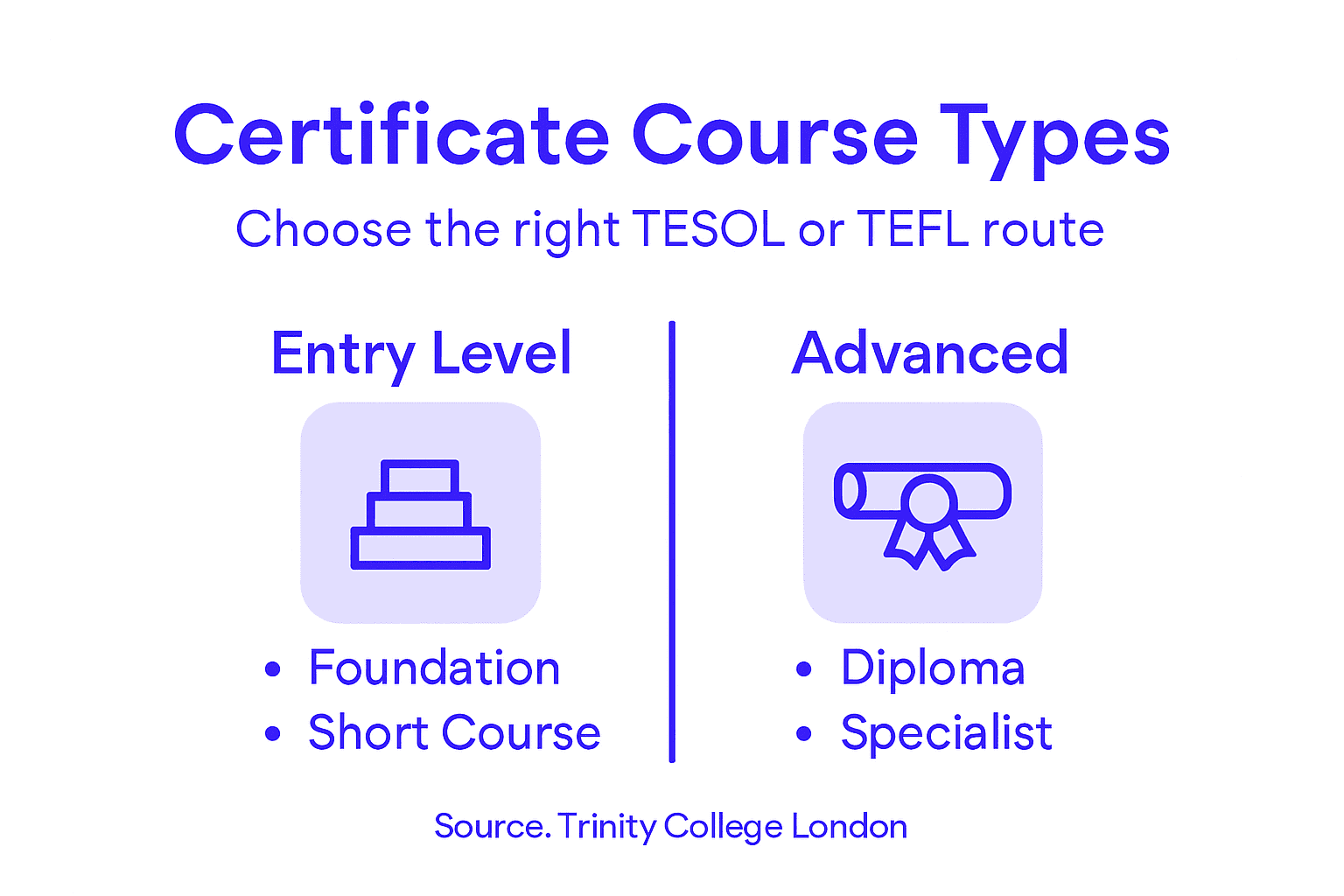
The landscape of TEFL and TESOL courses ranges from foundation certificates to advanced diplomas. Your choice depends on your experience level, teaching environment preference, and timeline.
Foundation-level certifications
Trinity CertTESOL and equivalent level certifications form the entry point for most English teachers. These programmes typically require 120 hours of training and include observed teaching practice with real students.
Foundation certifications cover:
- Language systems and teaching methodology
- Lesson planning and materials development
- Student assessment and feedback techniques
- Classroom management fundamentals
- Online or face-to-face delivery options
These qualifications make you immediately employable in language schools, private institutes, and corporate training environments globally.
Specialised certificate pathways
Once you hold a foundation certification, you can pursue specialised qualifications addressing specific teaching contexts. Different TESOL certification types allow you to develop expertise in niche areas that employers actively seek.
Popular specialised certificates include:
- Business English Teaching – corporate training and professional communication
- Online Teaching Certification – virtual classroom management and technology integration
- Young Learners Specialisation – teaching children and adolescents
- CLIL (Content and Language Integrated Learning) – subject teaching through English
Specialised certifications significantly increase your earning potential and job prospects in competitive markets.
Diploma programmes and advanced qualifications
Diploma qualifications represent advanced, comprehensive teacher training (usually 300+ hours). These suit experienced teachers seeking promotion, training roles, or university-level teaching.
Diplomas provide:
Here’s how the main types of ESL teaching qualifications compare:
| Qualification Level | Typical Duration | Career Outcome | Example Qualification |
|---|---|---|---|
| Foundation Certificate | 4–8 weeks | Entry-level language teaching | Trinity CertTESOL |
| Specialised Certificate | 2–6 weeks | Niche teaching roles | Business English, Online TESOL |
| Advanced Diploma | 6–12 months | Management/Trainer/University | DipTESOL |
- Deeper theoretical knowledge of language acquisition and pedagogy
- Research and development skills for curriculum design
- Trainer certification to deliver teacher training programmes
- Career pathways to management and academic roles
Choosing between course formats
TEFOL and TESOL courses are delivered through multiple formats: intensive full-time programmes, part-time evening courses, blended learning, and fully online options. Your lifestyle and commitments determine the best format.
Full-time intensive courses typically last 4 weeks and suit those leaving employment or pursuing a career change quickly. Part-time courses span 3–6 months and work for those maintaining employment. Online courses offer maximum flexibility with asynchronous learning.
Pro tip: When comparing courses, prioritise accreditation over cost—a Trinity-accredited certification remains valuable globally throughout your entire teaching career, whilst unaccredited courses often limit employment opportunities.
One-year study and work abroad options
One-year study and work abroad programmes combine professional qualifications with immersive cultural experiences. These integrated packages allow you to earn a Trinity certification, develop language skills, and gain paid teaching experience simultaneously in countries like Spain, France, and Italy.
Unlike traditional courses that end after certification, one-year programmes transform your entire year into a structured career-building experience. You study, work, and live abroad—building genuine expertise rather than just collecting credentials.
The comprehensive programme structure
One-year study and work options typically integrate four core components into a cohesive experience. Your year unfolds progressively, building skills and confidence whilst generating income.
Core components include:
- Trinity CertTESOL or equivalent qualification – completed in the first 4–8 weeks
- Language study programme – developing proficiency in Spanish, French, or Italian throughout the year
- Paid teaching position – securing employment once certification is complete
- Cultural immersion and professional development – networking, travel, and career building
This structure means you’re not waiting months after training to find work. Instead, your employer is often arranged before your certification concludes.
Why one-year programmes outperform standalone courses
Standalone TEFL certifications leave you to navigate visa requirements, job searches, and accommodation independently. One-year programmes handle these logistics, allowing you to focus on teaching excellence and cultural adaptation.
Extended teaching experience abroad develops skills you cannot acquire in a 4-week training course. You learn classroom management under real conditions, understand student motivation, and adapt your teaching continuously.
Key advantages include:
- Visa sponsorship and support throughout your stay
- Guaranteed teaching position with salary negotiated in advance
- Language study integrated into your schedule
- Accommodation assistance and cultural orientation
- Professional network development with teachers and schools
One-year programmes deliver genuine career transformation, not just certification—you return home with international teaching experience, language competency, and professional relationships.
Geographic options: Spain, France, Italy, and beyond
Three primary European destinations dominate one-year offerings. Each presents distinct advantages depending on your career goals and lifestyle preferences.
Spain attracts teachers seeking warm climate, affordable living, and extensive English teaching demand. France appeals to those prioritising cultural richness and higher salaries. Italy combines lifestyle advantages with growing demand for qualified English teachers.
Beyond Europe, Asian markets—particularly Thailand, Vietnam, and China—offer one-year programmes with premium salaries and substantial career development potential.
Financial reality of one-year programmes
Most one-year programmes offset costs through teaching salaries. You earn whilst training, allowing self-funded participation. Programme fees cover Trinity certification, visa support, and placement assistance—investments that return value through guaranteed employment.
Conseil pro: Before committing, verify that your programme includes visa sponsorship documentation, employer introduction guarantees, and lifetime job placement support—these differentiators determine whether your year abroad transforms your career permanently.
Global employment and lifetime job support benefits
Accredited TEFL qualifications open employment pathways that non-accredited certificates simply cannot match. Beyond landing your first teaching position, Trinity-certified teachers access lifetime job placement support—a commitment that strengthens your career across decades, not just years.
This ongoing support transforms your qualification from a one-time credential into a permanent professional asset. You’re never competing alone in the job market again.
Lifetime job placement: How it works
Unlike stand-alone training that ends after certification, accredited programmes guarantee access to job boards, employer networks, and placement specialists for life. This means you can change careers, relocate internationally, or transition teaching roles—always with institutional backing.
Lifetime support typically includes:
- Access to exclusive job boards featuring positions worldwide
- Direct connections with employers actively hiring Trinity-certified teachers
- Resume and application feedback from experienced placement advisors
- Visa sponsorship guidance for new countries
- Career transition advice when circumstances change
- Networking events connecting graduates across global communities
Global employment networks and demand
Triumph-certified teachers access employment opportunities across 180+ countries. The demand for qualified English teachers significantly outpaces supply in most regions, meaning your qualification remains valuable regardless of where life takes you.
Teaching English abroad benefits extend across professional, financial, and personal dimensions. Schools in Spain, France, Italy, China, Thailand, United Arab Emirates, and Saudi Arabia actively recruit Trinity-qualified educators, often with substantial salary packages.
Key employment markets include:
Below is a quick guide to teaching opportunities by region for Trinity-accredited teachers:
| Region | Top Destinations | Typical Benefits |
|---|---|---|
| Europe | Spain, France, Italy | Cultural richness, steady demand |
| Asia-Pacific | China, Thailand, Vietnam | Premium salaries, fast tracking |
| Middle East | UAE, Saudi Arabia, Qatar | High pay, tax advantages |
| Latin America | Mexico, Brazil, Colombia | Lower costs, fast progression |
- Europe – Spain, France, Italy, Portugal, and Turkey offer competitive salaries and cultural richness
- Asia-Pacific – China, Thailand, Vietnam, South Korea provide premium compensation and rapid career progression
- Middle East – United Arab Emirates, Saudi Arabia, Qatar offer exceptional remuneration packages
- Latin America – Mexico, Brazil, Colombia feature growing demand and reasonable living costs
Your Trinity qualification opens doors globally—employers actively seek certified teachers, not the reverse.
Financial impact of accreditation
Accredited teachers earn significantly more than unaccredited counterparts. Salary differences typically range from 20–50% depending on location and institution type. A Trinity CertTESOL qualifier might earn £1,200–1,500 monthly in Spain versus £800–1,000 without accreditation in identical roles.
Over a 10-year teaching career, this differential compounds substantially. Lifetime access to job placement assistance ensures you negotiate optimal salaries rather than accepting first offers.
How accreditation creates career resilience
Accredited qualifications provide professional security through continuous support. If you lose employment, face relocation, or seek career advancement, your accreditation—combined with lifetime placement access—ensures rapid reemployment.
Non-accredited teachers lack this institutional backing. They’re entirely self-directed in finding new positions, often discovering their credentials carry limited recognition in competitive markets.
Pro tip: When evaluating programmes, confirm lifetime job placement support in writing—verify whether support extends indefinitely and includes access to active job boards, not just occasional emails about opportunities.
Unlock Your Global Teaching Career with Trinity-Accredited Training and One-Year Programmes
If you are eager to overcome the challenges of securing a credible ESL teaching qualification that guarantees worldwide recognition and lifetime job support, our Trinity College London accredited courses at EBC TEFL offer the solution you need. With a focus on practical, hands-on teacher training including the internationally respected Trinity CertTESOL and specialised certifications, we prepare you thoroughly for real classroom success and access to thriving global job markets across Spain, France, Italy, and Asia.

Discover the difference a Trinity-accredited qualification makes and build your career through our unique one-year study and work abroad programmes. These comprehensive packages combine accredited teacher training, immersive language study, visa support, and paid teaching opportunities to ensure you gain valuable experience and cultural insight. Benefit from free lifetime job placement assistance that keeps your career moving forward no matter where life takes you. Take the first step today by scheduling your free consultation at EBC TEFL and explore detailed course options, success stories, and expert guidance to start teaching English abroad with confidence.
Frequently Asked Questions
What is an ESL teaching qualification?
An ESL teaching qualification is a professional certification that confirms your ability to teach English to non-native speakers effectively. It combines theoretical knowledge with practical skills necessary for effective classroom management and lesson delivery.
Why is accreditation important for ESL qualifications?
Accreditation is essential as it ensures that the qualification meets rigorous international standards. This enhances your employability and signals professionalism to potential employers, making you a more competitive candidate.
What does the Trinity CertTESOL entail?
The Trinity CertTESOL is an internationally recognised qualification for teaching English to speakers of other languages. It includes comprehensive coursework, assessed teaching practice, and continuous professional development opportunities, preparing you for real classroom scenarios.
How do specialised certificate pathways benefit ESL teachers?
Specialised certificate pathways allow teachers to focus on niche areas of English teaching, such as Business English or teaching young learners. These qualifications can significantly enhance your job prospects and earning potential in competitive markets.