
Many aspiring English teachers mistakenly believe a simple online certificate is sufficient to secure teaching positions across Europe. The reality is far more nuanced. Countries like Spain, France, and Italy require specific academic credentials, recognised certifications, and demonstrable language proficiency. Understanding these requirements is essential before embarking on your teaching journey. This guide examines the qualifications you need, explains why Trinity CertTESOL stands out as the gold standard certification, and clarifies country-specific expectations to help you make informed decisions about your teaching career in Europe.
Table of Contents
- Key takeaways
- Understanding the minimum qualifications to teach English abroad
- Exploring accredited qualifications: Trinity CertTESOL and why it matters
- Comparing Trinity CertTESOL with CELTA: choosing the right certification
- Qualifications and requirements for teaching English in Spain, France, and Italy
- Enhance your teaching career with Trinity CertTESOL courses
- Frequently asked questions
Key Takeaways
| Point | Details |
|---|---|
| Degree for visas | In Spain, France and Italy a degree is typically required for work visas, so having a recognised certificate alone may not be enough to secure a position. |
| Trinity CertTESOL gold standard | Trinity CertTESOL is presented as the gold standard, offering a practical framework with 130 hours input, 70 hours self study and six hours of observed teaching practice. |
| Online certificates insufficient | Not all online certificates prepare you for real classrooms whereas recognised qualifications and language proficiency are valued by employers and immigration authorities. |
| CertTESOL vs CELTA | Both Trinity CertTESOL and CELTA offer routes to teach abroad but they differ in approach and international recognition. |
Understanding the minimum qualifications to teach English abroad
Before exploring specific certifications, you need to understand the baseline requirements that govern entry into English teaching programmes and subsequent employment across Europe. These prerequisites form the foundation upon which your teaching career is built.
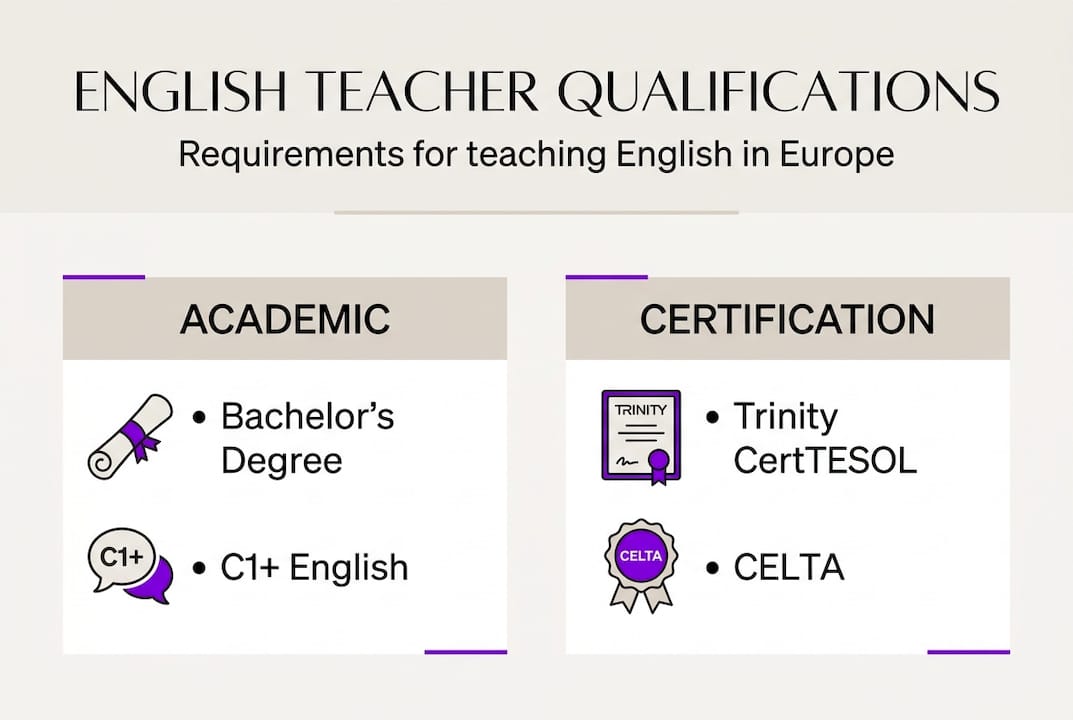
Most Trinity CertTESOL programmes require minimum age 18, a high school diploma or equivalent for higher education entry, and strong English proficiency at C1 level or native speaker standard. Crucially, no prior teaching experience is necessary to enrol, making these certifications accessible to career changers and recent graduates alike. This accessibility, however, does not diminish the rigour of the training itself.
The essential prerequisites include:
- Minimum age of 18 years for programme enrolment
- High school diploma or equivalent qualification recognised for tertiary education entry
- English language proficiency at C1 (advanced) level or native speaker competency
- No previous classroom teaching experience required for initial certification
- Bachelor’s degree in any discipline for visa sponsorship in most European countries
The bachelor’s degree requirement deserves particular attention. Whilst not mandatory for enrolling in Trinity CertTESOL training, it becomes essential when applying for work visas in Spain, France, and Italy. Many aspiring teachers discover this requirement too late, after completing their TEFL certification. Language schools in these countries prioritise candidates who can legally work, and immigration authorities typically require degree-level education for non-EU nationals seeking teaching positions.
Pro Tip: If you lack a bachelor’s degree but are committed to teaching in Europe, consider completing your degree through distance learning whilst gaining initial teaching experience in countries with more flexible visa requirements, then transition to your preferred European destination.
Your English proficiency must extend beyond conversational fluency. Teaching requires the ability to explain grammatical structures, identify pronunciation patterns, and articulate language concepts clearly. Native speakers sometimes assume their fluency is sufficient, but effective teaching demands metalinguistic awareness that only comes through structured training and reflection on language systems.
Exploring accredited qualifications: Trinity CertTESOL and why it matters
Trinity CertTESOL represents the gold standard in English language teaching certification, distinguished by its practical focus and international recognition. Understanding its structure reveals why it consistently outperforms alternative qualifications in preparing teachers for real classroom challenges.
The course comprises 130 hours input plus 70 hours self-study, with six hours of observed teaching practice that forms the cornerstone of your development. This structure ensures you gain both theoretical knowledge and practical application before entering your first professional classroom. The course is divided into five integrated units that address every dimension of effective teaching.
The five core units develop complementary competencies:
- Teaching Skills unit focuses on lesson planning, classroom management, and instructional techniques through direct practice
- Language Awareness unit deepens your understanding of English grammar, phonology, and lexis from a teacher’s perspective
- Learner Profile unit requires detailed analysis of individual student needs, learning styles, and contextual factors
- Materials Assignment unit develops your ability to evaluate, adapt, and create teaching resources appropriate for diverse learners
- Unknown Language unit places you in the learner’s position, studying a language unfamiliar to you to build empathy and insight
This comprehensive approach contrasts sharply with online TEFL courses that emphasise theory over practice. Many 120-hour online certificates include no observed teaching whatsoever, leaving graduates unprepared for the realities of managing multilingual classrooms, adapting to unexpected student questions, or responding to diverse learning needs in real time.
The Level 5 Ofqual accreditation positions Trinity CertTESOL at degree-level equivalency, recognised by employers and immigration authorities worldwide. This accreditation is particularly valued in Spain, France, and Italy, where language schools face increasing pressure to demonstrate teacher quality to parents and educational authorities. Schools advertising positions frequently specify “Trinity CertTESOL or CELTA” as minimum requirements, effectively excluding holders of unaccredited certificates.
Pro Tip: When researching TEFL courses, always verify Ofqual accreditation status directly through the official register. Marketing claims about “international recognition” mean little without formal accreditation backing them.
“Trinity CertTESOL transformed my understanding of language teaching. The observed teaching practice was challenging but invaluable. I entered my first job in Barcelona confident and prepared, whilst colleagues with online certificates struggled with basic classroom management.”
The reflective and learner-centred methodology embedded throughout Trinity CertTESOL develops adaptive teachers who respond to student needs rather than rigidly following scripted lesson plans. This flexibility proves essential in European classrooms, where you might teach young learners in the morning, business professionals at midday, and exam preparation classes in the evening, each requiring distinct approaches and materials.
Comparing Trinity CertTESOL with CELTA: choosing the right certification
Both Trinity CertTESOL and Cambridge CELTA dominate the English teaching certification landscape, yet they differ in philosophy and approach. Understanding these distinctions helps you select the qualification aligned with your teaching style and career objectives.
Both hold Level 5 accreditation and global recognition, making them equally respected by employers worldwide. The critical differences lie in pedagogical approach, assessment methodology, and the skills each prioritises. Trinity CertTESOL emphasises reflective practice, personalised teaching development, and deep exploration of phonology and learner profiles. CELTA follows a more structured, formulaic syllabus suited to teachers who prefer systematic frameworks and clearly defined teaching procedures.
| Feature | Trinity CertTESOL | Cambridge CELTA |
|---|---|---|
| Accreditation | Level 5 Ofqual | Level 5 Ofqual |
| Teaching practice | 6 hours observed | 6 hours observed |
| Phonology focus | Extensive, dedicated unit | Integrated within broader units |
| Assessment style | Reflective, portfolio-based | Structured, criteria-focused |
| Learner analysis | Detailed individual profiles required | Integrated within lesson planning |
| Teaching approach | Flexible, adaptive methodology | Systematic, procedure-driven |
| Global recognition | Worldwide acceptance | Worldwide acceptance |
The Trinity CertTESOL Unknown Language component provides a unique perspective absent from CELTA. By placing you in the student’s position, learning a language completely unfamiliar to you, the course builds genuine empathy for learner challenges. This experience profoundly influences how you approach teaching, making you more patient, creative, and responsive to student frustration and confusion.
Key decision factors include:
- Teaching style preference: reflective and adaptive versus structured and systematic
- Phonology interest: Trinity offers deeper exploration of pronunciation teaching
- Assessment comfort: portfolio and reflection versus observed lesson criteria
- Course availability: location and scheduling options in your region
Neither certification is objectively superior. CELTA’s structured approach suits teachers who thrive with clear frameworks and systematic procedures. Trinity CertTESOL appeals to those who prefer reflective practice and personalised development. Both significantly improve teaching effectiveness and student achievement when applied thoughtfully.
Research consistently demonstrates that teachers holding either qualification outperform those with unaccredited online certificates across multiple dimensions: lesson planning coherence, classroom management effectiveness, student engagement levels, and learning outcome achievement. The observed teaching practice component, present in both but absent from most online courses, accounts for much of this performance difference.
Employers in Spain, France, and Italy recognise this quality distinction. Job advertisements routinely specify Trinity CertTESOL or CELTA as minimum requirements, particularly for positions in reputable language schools and international institutions. Budget academies might accept unaccredited certificates, but these positions typically offer lower salaries, larger class sizes, and less professional support.
Qualifications and requirements for teaching English in Spain, France, and Italy
European countries maintain distinct qualification and visa requirements that directly impact your employment prospects. Understanding these country-specific expectations prevents costly mistakes and positions you for successful job applications.

Bachelor’s degrees are required or strongly preferred for work visa sponsorship across Spain, France, and Italy, with minimum 120-hour TEFL qualifications like Trinity CertTESOL essential for competitive positions. Spain enforces a legal minimum of 120 hours TEFL training and operates the government Auxiliares programme that places language assistants in state schools. France’s TAPIF programme similarly encourages certified teachers with TESOL qualifications, whilst Italy’s private language school sector dominates the market.
| Country | Degree requirement | TEFL minimum | Visa considerations | Salary range (monthly) |
|---|---|---|---|---|
| Spain | Required for visa | 120 hours legal minimum | EU citizens preferred, non-EU challenging | €1,000-€1,500 |
| France | Required for visa | 120 hours recommended | TAPIF programme option | €800-€1,400 |
| Italy | Strongly preferred | 120 hours recommended | Private schools dominate | €900-€1,600 |
Spain’s Auxiliares de Conversación programme offers an accessible entry point for new teachers, providing work permits and placement in state schools across the country. However, positions are competitive, and holding a Trinity CertTESOL certification significantly strengthens your application. The programme pays approximately €1,000 monthly for 16 hours weekly teaching, allowing time for private tutoring to supplement income.
France’s TAPIF programme operates similarly, placing English teaching assistants in primary and secondary schools throughout the country. The programme explicitly values candidates with recognised TEFL qualifications, viewing them as better prepared for classroom responsibilities. Salary is modest at approximately €800 monthly, but the programme provides valuable experience and cultural immersion whilst you build your teaching portfolio.
Italy lacks a comparable government programme, making private language school employment the primary pathway. Schools in major cities like Rome, Milan, and Florence actively recruit qualified teachers, but visa sponsorship for non-EU nationals remains challenging. Many teachers initially enter on student visas whilst completing Italian language studies, then transition to work permits once established.
Critical considerations for each country:
- Spain: Legal 120-hour minimum enforced, degree essential for visa, Auxiliares programme competitive
- France: TAPIF offers structured entry, degree required, Paris market saturated but provincial cities accessible
- Italy: Private school market dominant, degree strongly preferred, visa sponsorship limited for non-EU
- All three: Trinity CertTESOL or CELTA significantly improve employment prospects over unaccredited certificates
Non-native English speakers with C1+ proficiency face additional challenges. Whilst legally permitted to teach with appropriate qualifications, some private academies maintain native-speaker preferences driven by parent expectations rather than teaching effectiveness research. However, schools prioritising teacher quality over accent increasingly recognise that well-qualified non-native teachers often provide superior grammar instruction and learner empathy.
Salary expectations vary considerably based on location, institution type, and your qualifications. Teachers with Trinity CertTESOL typically command higher rates than those holding unaccredited certificates, reflecting employer recognition of superior training quality. Private tutoring supplements income significantly, with rates of €20-€40 hourly common in major cities for qualified teachers.
Enhance your teaching career with Trinity CertTESOL courses
Transforming your teaching aspirations into reality requires more than understanding qualification requirements. It demands access to accredited training that develops the practical skills employers seek and immigration authorities recognise.
EBC TEFL offers comprehensive Trinity CertTESOL courses designed specifically for aspiring teachers targeting European markets. Our programmes combine rigorous academic training with extensive practical teaching experience, ensuring you enter your first classroom confident and prepared. With Level 5 Ofqual accreditation, our certification opens doors across Spain, France, Italy, and beyond, backed by lifetime job placement support that continues long after course completion.
Our global network connects you with teaching opportunities worldwide, from language schools in Barcelona to international institutions in Paris and corporate training centres in Milan. We understand the unique challenges of securing work visas, navigating foreign job markets, and adapting to diverse classroom cultures. Our support extends beyond certification, offering guidance on teaching abroad requirements, visa applications, and career development strategies tailored to your goals.
Whether you’re a recent graduate exploring career options or an experienced professional seeking international opportunities, Trinity CertTESOL provides the recognised qualification and practical skills that transform teaching aspirations into successful careers. Book a consultation to discuss your specific situation, explore course options, and develop a personalised pathway to teaching English in Europe.
Frequently asked questions
Do I need a bachelor’s degree to teach English in Europe?
Yes, most European countries including Spain, France, and Italy require bachelor’s degrees for work visa sponsorship, regardless of your TEFL qualification. Whilst you can complete Trinity CertTESOL without a degree, employment opportunities remain limited without one. EU citizens face fewer restrictions, but non-EU nationals find degree requirements strictly enforced by immigration authorities.
Is Trinity CertTESOL better than a 120-hour online TEFL certificate?
Trinity CertTESOL significantly outperforms online certificates through Level 5 Ofqual accreditation, observed teaching practice, and comprehensive skills development. Employers in Spain, France, and Italy routinely specify Trinity CertTESOL or CELTA as minimum requirements, effectively excluding online certificate holders from quality positions. The practical teaching component ensures classroom readiness that theory-only courses cannot provide.
Can non-native English speakers obtain Trinity CertTESOL certification?
Absolutely, provided you demonstrate C1 level English proficiency or above. Trinity CertTESOL welcomes non-native speakers who often bring valuable linguistic awareness and learner empathy to their teaching. Some private language schools maintain native-speaker preferences, but institutions prioritising teaching quality increasingly recognise that accent matters far less than pedagogical skill and language knowledge.
How long does Trinity CertTESOL certification take to complete?
Full-time intensive courses typically run four to five weeks, whilst part-time options extend over several months to accommodate working professionals. Both formats include 130 hours of input sessions, 70 hours of self-study, and six hours of observed teaching practice. Course duration varies by provider, but qualification standards remain consistent regardless of schedule format.
What salary can I expect teaching English in Spain, France, or Italy?
Salaries range from €800-€1,600 monthly depending on country, location, and institution type. Spain typically offers €1,000-€1,500, France €800-€1,400, and Italy €900-€1,600 for full-time positions. Private tutoring supplements income significantly, with qualified teachers earning €20-€40 hourly. Trinity CertTESOL holders generally command higher rates than those with unaccredited certificates, reflecting superior training quality recognised by employers.