
Choosing the right teaching method shapes your effectiveness as a TEFL instructor and determines how confidently you adapt to diverse classroom environments worldwide. With numerous approaches available, from traditional grammar-focused techniques to modern communicative models, aspiring English teachers face a critical decision that influences both learner outcomes and career progression. This article provides a structured framework to evaluate teaching methods, explores core approaches and instructional models, and compares grammar instruction strategies to help you select methods that align with your teaching philosophy and student needs.
Table of Contents
- Evaluating Criteria To Choose The Right Teaching Method
- Core Teaching Methods Every TEFL Teacher Should Know
- Modern Instructional Models: PPP And ESA Explained
- Comparing Inductive And Deductive Grammar Instruction
- Enhance Your TEFL Career With Expert Training And Certification
- Frequently Asked Questions
Key takeaways
| Point | Details |
|---|---|
| Multiple methods suit different contexts | Effective TEFL teaching integrates various approaches tailored to learner profiles and lesson objectives |
| Evaluation criteria guide selection | Assess teaching style, learner characteristics, class size, and course goals before choosing methods |
| PPP and ESA offer flexible frameworks | These modern models provide structured yet adaptable approaches for lesson planning and delivery |
| Grammar instruction varies by approach | Inductive and deductive methods each offer distinct benefits depending on learner preferences and experience |
| Blending methods maximises effectiveness | Combining explicit and implicit techniques creates dynamic lessons that engage diverse student populations |
Evaluating criteria to choose the right teaching method
Before selecting a teaching method, you need a clear framework that aligns with your instructional beliefs and learner requirements. Start by defining your core teaching philosophy. Do you believe language acquisition happens through immersion and communication, or through explicit grammar study and translation? Your answer shapes which methods feel natural and sustainable in your practice.
Next, assess your learner profiles comprehensively. Consider age ranges, native language backgrounds, current proficiency levels, and learning goals. Younger learners often respond better to interactive, game-based approaches, whilst adult professionals may prefer structured, goal-oriented methods. Teaching multilingual students requires sensitivity to linguistic diversity and cultural learning preferences.
Examine your lesson context carefully. Class size dramatically affects method viability. A communicative approach thrives in small groups but struggles with 40 students. Teaching setting matters too: private language schools allow flexibility, whilst state schools may require curriculum alignment. Course objectives determine whether you prioritise fluency, accuracy, exam preparation, or functional communication.
Identify methods that complement your natural teaching strengths and personality. Extroverted teachers often excel with communicative, drama-based approaches. Analytical instructors may prefer systematic, grammar-focused methods. Teachers should choose methods that align with their teaching style, student level, and learning goals, ensuring authentic delivery that students perceive as genuine.
Pro Tip: Balance explicit grammar instruction with implicit communicative practice. Research shows integrated methodologies for ESL teaching at university level require approaches matching learners’ backgrounds and aspirations, creating comprehensive skill development across listening, speaking, reading, and writing domains.
Consider these evaluation questions:
- Does this method suit my learners’ age and proficiency?
- Can I implement it effectively given my class size and resources?
- Does it align with my course objectives and assessment requirements?
- Will it engage students and maintain motivation over time?
- Does it balance accuracy development with fluency practice?
Core teaching methods every TEFL teacher should know
Understanding foundational teaching methods provides essential knowledge for adapting instruction to varied contexts. Each approach offers unique advantages and limitations worth examining closely.
The Direct Method emphasises target language use, vocabulary with visuals, and Q&A, creating immersive environments where English dominates classroom interaction. Teachers avoid translation, instead using gestures, images, and demonstrations to convey meaning. This approach builds strong speaking and listening skills quickly, particularly for beginners motivated by immediate communication. However, it demands high teacher proficiency and can frustrate learners needing explicit grammar explanations.
The Grammar-Translation approach focuses on grammar rules and vocabulary for translation, deriving from classical language teaching traditions. Students analyse sentence structures, memorise vocabulary lists, and translate passages between native and target languages. This method suits learners preparing for written exams or academic reading, providing systematic grammar knowledge. Critics argue it neglects speaking skills and fails to develop communicative competence needed for real-world interaction.
Suggestopedia involves suggestion and pedagogy with elaboration and concert sessions, developed by Georgi Lozanov to reduce learning anxiety through music, comfortable environments, and positive suggestion. Teachers create relaxed atmospheres using classical music, dramatic readings, and playful activities. Whilst innovative, this method requires specialised training and resources not always available in standard teaching contexts.
| Method | Best Context | Key Strength | Main Limitation |
|---|---|---|---|
| Direct Method | Immersion programmes, small classes | Rapid speaking fluency | Requires native-level teacher proficiency |
| Grammar-Translation | Academic settings, exam preparation | Systematic grammar knowledge | Weak communicative competence |
| Suggestopedia | Private schools, adult learners | Reduced anxiety, creative engagement | Resource-intensive, limited research base |
| Audio-Lingual | Military, intensive courses | Habit formation through drills | Mechanical, limited creativity |
Pro Tip: Blend traditional grammar focus with communicative activities for balanced skill development. Use grammar-translation approach example techniques for written accuracy, then transition to speaking tasks applying those structures in meaningful contexts. This hybrid approach addresses diverse learner preferences whilst building comprehensive language competence.
Modern TEFL practice rarely uses single methods exclusively. Instead, effective teachers draw strategically from multiple approaches, adapting techniques to specific lesson objectives and learner needs. Understanding these foundational methods provides the toolkit for such flexible, responsive teaching. Explore lesson planning tips to integrate various methods coherently within structured lesson frameworks.
Modern instructional models: PPP and ESA explained
Contemporary TEFL relies heavily on two instructional models that provide structured yet flexible frameworks for lesson delivery. Understanding when and how to apply PPP and ESA enhances your planning effectiveness and classroom adaptability.
The Presentation-Practice-Production (PPP) model follows a fixed three-stage sequence. During presentation, teachers introduce new language through examples, explanations, or discovery activities. Practice involves controlled exercises where students manipulate the target language with teacher guidance. Production allows freer communication where learners use the new language independently in realistic contexts. PPP is effective for teaching specific grammar points, especially for lower-level students through explicit instruction that builds confidence systematically.
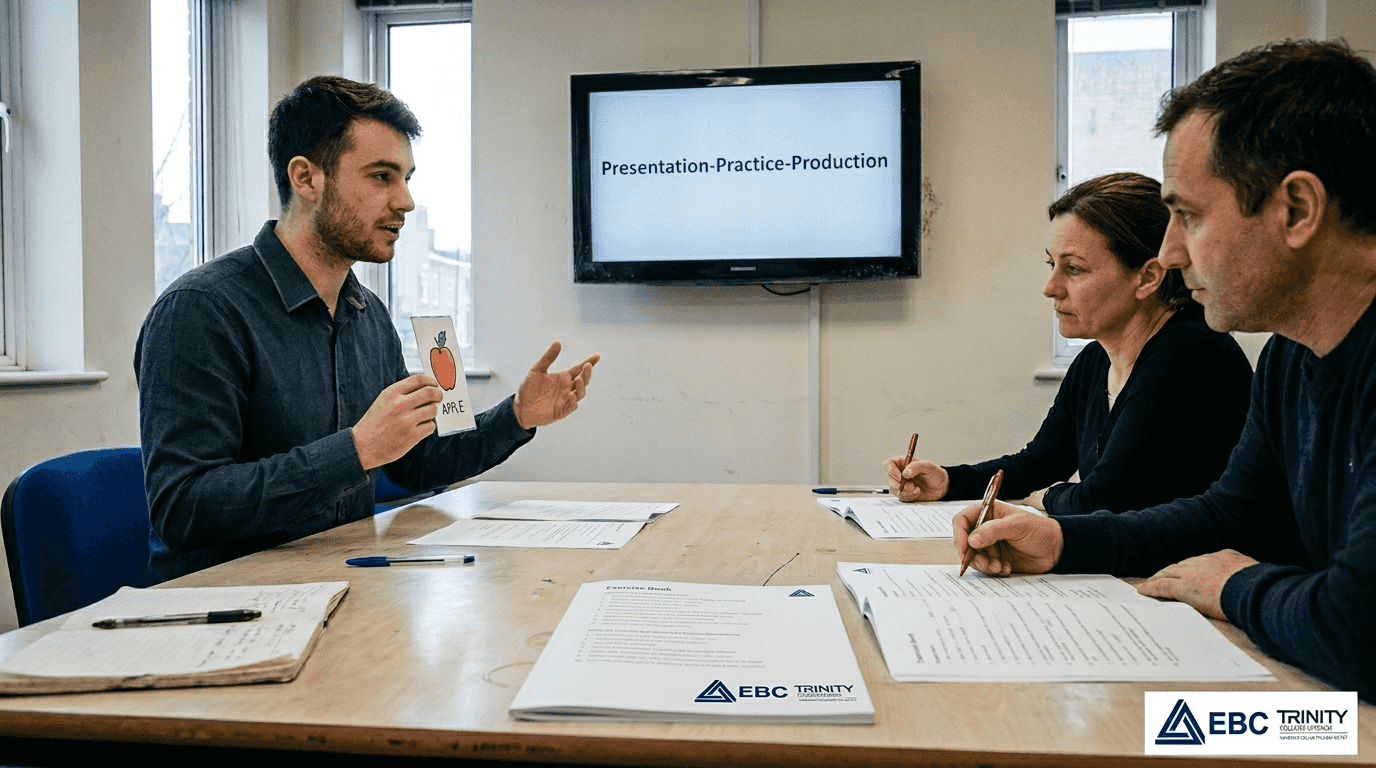
The Engage-Study-Activate (ESA) model offers flexible sequencing of three elements. Engage activities capture interest and activate prior knowledge through games, discussions, or provocative questions. Study focuses on language analysis, whether grammar rules, vocabulary, or functional expressions. Activate provides opportunities to use language freely in communicative tasks. Unlike PPP’s rigid order, ESA allows multiple sequences: straight (E-S-A), boomerang (E-A-S-A), or patchwork (E-S-E-A-S-A).
Choosing between models:
- Use PPP when teaching discrete grammar points to lower-level learners needing systematic guidance
- Apply ESA when learners arrive tired or distracted, starting with engaging activities
- Select PPP for exam preparation requiring accuracy and controlled practice
- Choose ESA for mixed-ability classes needing differentiated activation tasks
- Employ PPP in teacher-centred contexts with large classes
- Implement ESA in learner-centred environments encouraging autonomy
| Feature | PPP | ESA |
|---|---|---|
| Sequence | Fixed: always P-P-P | Flexible: multiple orderings possible |
| Best for | Explicit grammar teaching | Engagement and varied dynamics |
| Teacher role | Directive, controlling stages | Facilitative, responsive to energy |
| Student autonomy | Lower, guided progression | Higher, active participation |
| Planning complexity | Straightforward, predictable | Requires adaptability, reading class |
ESA helps with student engagement and lesson flexibility, suitable for tired learners or varied class dynamics where rigid sequencing feels forced.
Pro Tip: Match your model choice to learner energy levels and lesson aims. Begin Monday morning classes with engaging activities (ESA) to wake students up. Save systematic PPP sequences for mid-week lessons when focus peaks. This strategic selection maintains motivation whilst ensuring comprehensive language coverage. Consult planning accredited lessons for frameworks integrating these models into Trinity-accredited teaching practice.
Both models work effectively when applied appropriately. PPP provides clarity and structure for explicit teaching. ESA offers dynamism and responsiveness for varied classroom realities. Master both approaches to handle diverse teaching contexts confidently. Apply keeping students attentive strategies within either framework to maximise engagement and learning outcomes.
Comparing inductive and deductive grammar instruction
Grammar instruction strategy significantly influences how effectively students internalise language rules and apply them communicatively. Two contrasting approaches dominate TEFL practice, each offering distinct pedagogical benefits.
Deductive instruction presents rules first, followed by examples and practice. Teachers explain grammar explicitly, often using terminology and diagrams, then students apply rules through controlled exercises. This approach suits learners who prefer systematic, logical progression and feel secure with explicit knowledge. It saves time in exam-focused contexts and works well for simple, regular grammar patterns.
Inductive instruction reverses this sequence. Teachers provide examples first, guiding students to discover underlying patterns and formulate rules themselves. This approach promotes deeper cognitive processing, critical thinking, and longer retention. Students engage actively in noticing language features rather than passively receiving explanations.
Research reveals surprising findings about relative effectiveness. No significant difference in learning gains between inductive and deductive grammar instruction was found in controlled studies, suggesting both approaches produce comparable outcomes when implemented well. However, students perceived inductive instruction as more effective, interesting, and easier than deductive, indicating motivational and engagement advantages beyond measurable learning gains.
Importantly, explicit instruction benefits both receptive and productive grammar knowledge, supporting accuracy in both understanding and using target structures. This finding validates explicit grammar teaching against purely communicative approaches that minimise grammatical focus.
| Approach | Process | Advantages | Disadvantages |
|---|---|---|---|
| Deductive | Rule first, then examples | Time-efficient, clear, suits analytical learners | Passive, less engaging, limited critical thinking |
| Inductive | Examples first, infer rules | Active discovery, deeper processing, higher motivation | Time-consuming, frustrating for some, needs skilled facilitation |
| Mixed | Alternates based on context | Addresses diverse preferences, maintains variety | Requires careful planning, higher teacher expertise |
Pro Tip: Use a mixed approach tied to learners’ age, experience, and the grammar complexity. Teach simple, regular patterns deductively for efficiency. Employ inductive discovery for complex, irregular structures where noticing patterns aids retention. Young learners benefit from inductive, game-based discovery. Adult professionals often prefer deductive explanations they can reference independently.
Consider these factors when choosing your approach:
- Learner preference and prior educational experience
- Grammar complexity and regularity of the target structure
- Available lesson time and curriculum constraints
- Class size and feasibility of guided discovery activities
- Your confidence facilitating inductive learning processes
Explore grammar instruction tips for business English contexts where adult learners often appreciate explicit, deductive approaches that respect their analytical capabilities and time constraints. Adapt your grammar teaching strategy to context rather than rigidly following one approach exclusively.
Enhance your TEFL career with expert training and certification
Mastering diverse teaching methods requires more than theoretical knowledge. It demands practical training, expert feedback, and internationally recognised certification that validates your competence to employers worldwide.
EBC TEFL offers Trinity College London accredited programmes that equip you with hands-on teaching skills across multiple methodologies. Our courses combine rigorous academic content with supervised teaching practice, ensuring you confidently apply PPP, ESA, communicative approaches, and grammar instruction strategies in real classroom environments. Whether you pursue certification to teach English abroad or specialise in business, young learners, or online teaching, our expert trainers guide you through method selection and adaptation.
Gain practical experience applying the teaching methods explored in this article through our comprehensive training programmes. Our introduction to TEFL teaching courses prepare you for dynamic international classrooms, whilst our lesson planning success strategies ensure you integrate multiple methods coherently. Join a global network of certified teachers benefiting from lifetime job placement support, connecting you with teaching opportunities across continents. EBC’s worldwide presence means your certification opens doors in Asia, Europe, Latin America, and beyond, backed by our commitment to your career advancement.
Frequently asked questions
Which teaching method fits different learner levels and contexts?
Beginners benefit from Direct Method immersion or structured PPP sequences building foundational grammar. Intermediate learners thrive with communicative approaches and flexible ESA models encouraging fluency. Advanced students respond well to task-based learning and inductive grammar discovery. Always match method complexity to proficiency whilst considering class size, cultural expectations, and course objectives.
How do inductive and deductive grammar instruction differ in practice?
Deductive instruction explains rules first using terminology and diagrams, then applies them through exercises. Inductive instruction presents examples first, guiding students to notice patterns and formulate rules themselves. Research shows comparable learning outcomes, but students perceive inductive approaches as more engaging and interesting despite requiring more lesson time.
Can TEFL teachers combine different methods for better results?
Absolutely. Effective modern TEFL practice integrates multiple methods strategically rather than following single approaches rigidly. Blend grammar-focused techniques with communicative activities, use PPP for explicit teaching then ESA for engagement, and alternate deductive and inductive grammar instruction based on structure complexity and learner preferences. This eclectic approach addresses diverse learning styles whilst maintaining lesson variety.
What role do PPP and ESA models play in lesson planning?
PPP provides a structured three-stage framework ideal for teaching discrete grammar points systematically. ESA offers flexible sequencing of engage, study, and activate elements, adapting to learner energy and lesson dynamics. Both models organise lesson components coherently, ensuring balanced presentation, practice, and production opportunities. Choose based on teaching objectives, learner characteristics, and classroom context.
How important is matching a method to your teaching style?
Extremely important for authentic, sustainable teaching practice. Methods aligned with your natural strengths feel genuine to students and reduce teacher burnout. Extroverted teachers excel with communicative, interactive approaches. Analytical instructors thrive using systematic, grammar-focused methods. However, professional development requires expanding your methodological repertoire beyond comfort zones, building versatility for diverse teaching contexts worldwide.
Recommended
- Senior learners, how to teach English to them
- Why Teach English Online: Complete Guide for 2026 – EBC TEFL courses
- Master TEFL Job Search Methods for Global Teaching Success EBC TEFL courses EBC TEFL courses
- Six great tips to keep your students attentive and focussed – EBC TEFL courses
- Blog – Medical Interview Tips & Guides | Deepmock
- Master the multilingual call center process in 2026
