
Landing a TEFL job abroad promises more than scenic backdrops and exotic cuisine. For many aspiring teachers, the real challenge is finding opportunities that offer authentic cultural immersion and genuine support for global job placement. Engaging deeply with a new culture means actively participating in daily life, learning local customs, and navigating unfamiliar traditions, resulting in meaningful personal and professional growth. This guide uncovers how immersive experiences transform not just your teaching, but your worldview.
Table of Contents
- Cultural Immersion Defined and Demystified
- Types of Cultural Immersion Experiences Abroad
- How Cultural Immersion Transforms TEFL Teachers
- Requirements for Effective Immersion in Spain, France, Italy
- Risks, Costs, and What to Avoid When Immersing
- Alternatives to Full Cultural Immersion Programmes
Key Takeaways
| Point | Details |
|---|---|
| Cultural Immersion Defined | It involves deep engagement in cultural contexts, fostering genuine understanding beyond superficial interactions. |
| Types of Immersion Experiences | Experiences such as study abroad and international internships provide profound intercultural learning opportunities. |
| Transformative Impact on TEFL Teachers | Immersion enhances teachers’ adaptability and intercultural communication skills, reshaping their pedagogical approaches. |
| Importance of Preparation and Flexibility | Effective immersion requires psychological readiness, cultural sensitivity, and the ability to navigate unexpected challenges. |
Cultural Immersion Defined and Demystified
Cultural immersion represents a profound approach to experiencing and understanding cultures beyond superficial interactions. More than mere tourism, it involves intentional, deep engagement that transforms perspectives and builds genuine intercultural understanding.
Cultural immersion goes far beyond casual travel experiences. Deeply engaging with different cultural contexts requires participants to actively participate, learn local customs, and develop authentic connections with community members.
Key characteristics of cultural immersion include:
- Active participation in local events and traditions
- Learning the native language
- Developing genuine relationships with local community members
- Challenging personal preconceptions and biases
- Experiencing daily life from an insider’s perspective
Transformative learning occurs through intense, intentional interactions that push individuals outside their comfort zones. Experiential learning extends beyond classroom knowledge by fostering empathy, respect, and deep cultural understanding.
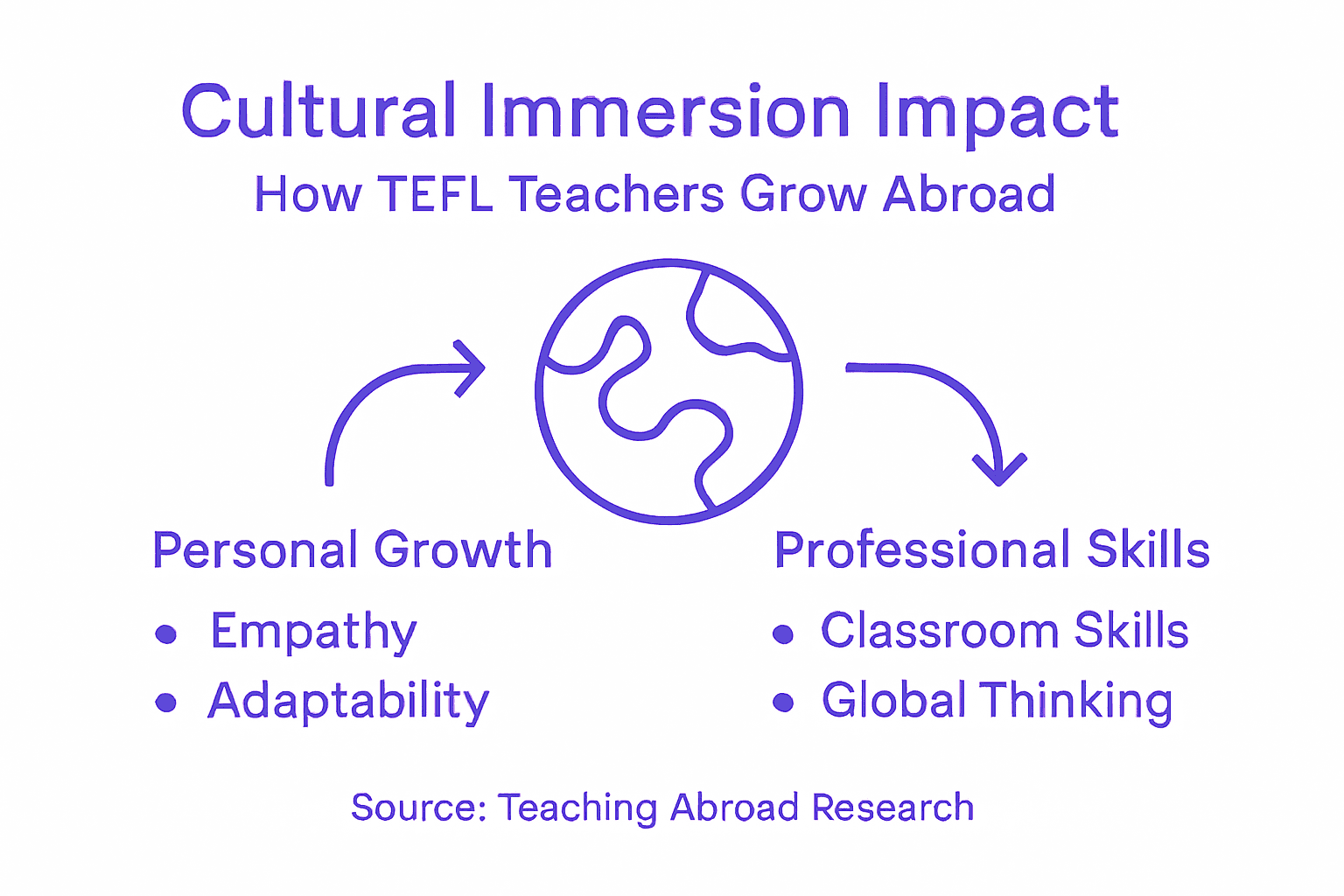
Successful cultural immersion demands more than passive observation. Participants must approach experiences with curiosity, humility, and a genuine desire to understand different perspectives. This means actively listening, participating, and reflecting on cross-cultural encounters.
Pro tip: Keep an open mind, ask thoughtful questions, and embrace moments of cultural uncertainty as opportunities for personal growth and learning.
Types of Cultural Immersion Experiences Abroad
Cultural immersion experiences abroad offer diverse pathways for individuals seeking profound intercultural understanding and personal growth. Various immersion program structures provide unique opportunities to engage deeply with different cultural contexts and develop global perspectives.
Study abroad programmes represent one of the most comprehensive immersion experiences. These structured academic journeys allow participants to live, study, and interact within a completely different cultural environment, typically lasting one semester or an entire academic year.
Key types of cultural immersion experiences include:
- Study abroad programmes (SAP)
- Global service learning projects
- International internships
- Exchange programmes
- Short-term cultural trips
- Volunteer experiences in foreign communities
Exchange programmes offer particularly intensive cultural interactions. Interdisciplinary immersion experiences often involve living with host families, attending local educational institutions, and participating in community activities.
Service learning projects provide another powerful immersion pathway. These experiences combine community service with cultural learning, enabling participants to contribute meaningfully while developing deep cross-cultural understanding. Participants engage directly with local communities, addressing real-world challenges while gaining unprecedented insights into local cultures.
International internships represent a professional approach to cultural immersion. By working within organisations in a foreign country, participants develop not just cultural understanding, but also valuable professional skills and global networking opportunities.

Pro tip: Choose an immersion experience that matches your personal learning goals and comfort level, and approach it with genuine curiosity and openness.
How Cultural Immersion Transforms TEFL Teachers
Cultural identity transformation represents a profound journey for TEFL teachers, challenging existing perspectives and reshaping professional understanding. Cultural immersion goes far beyond mere language acquisition, offering a transformative experience that fundamentally alters teaching approaches and personal worldviews.
Professional development emerges as a critical outcome of deep cultural engagement. Teachers who immerse themselves in new cultural contexts develop remarkable adaptability, gaining insights that traditional training cannot replicate. These experiences enable educators to understand nuanced communication styles, learning preferences, and cultural sensitivities.
Key transformative impacts for TEFL teachers include:
- Enhanced intercultural communication skills
- Deeper empathy towards diverse learning backgrounds
- More contextually responsive teaching strategies
- Improved ability to navigate cultural complexities
- Personal growth and expanded worldview
Pedagogical perspectives dramatically shift through immersion. Culturally responsive teaching practices emerge as teachers develop profound understanding of learners’ cultural contexts, enabling more meaningful and engaging educational experiences.
Reflective practice becomes second nature for immersed teachers. By experiencing vulnerability and uncertainty in a new cultural environment, educators develop heightened self-awareness and adaptability. They learn to deconstruct their preconceived notions, approach teaching with genuine curiosity, and create inclusive learning environments that celebrate cultural diversity.
Professional networking and global perspectives also expand significantly. Immersion experiences connect teachers with international educational communities, creating opportunities for collaborative learning, innovative teaching methodologies, and long-term professional growth.
Pro tip: Document your cultural immersion journey through reflective journals, actively seek local mentorship, and remain consistently open to learning from unexpected cultural encounters.
Requirements for Effective Immersion in Spain, France, Italy
Strategic cultural preparation forms the cornerstone of successful immersion experiences in Southern European countries. Effective immersion demands more than passive observation, requiring deliberate engagement and a proactive approach to understanding local nuances and cultural dynamics.
Language acquisition represents the foundational requirement for meaningful cultural integration. Teachers and learners must develop practical linguistic skills that extend beyond textbook knowledge, focusing on conversational fluency and regional dialect understanding specific to Spain, France, and Italy.
Key requirements for effective immersion include:
- Advanced language proficiency
- Willingness to live with local host families
- Active participation in community events
- Cultural sensitivity and adaptability
- Openness to new social experiences
- Commitment to continuous learning
Authentic engagement becomes critical in Southern European contexts. Cultural immersion through community interaction demands more than superficial involvement, requiring deep, meaningful connections with local communities.
Understanding regional social norms, communication styles, and unspoken cultural expectations proves essential. Each country presents unique contextual challenges, necessitating flexible approaches and genuine curiosity about local traditions, working practices, and interpersonal dynamics.
Psychological preparedness distinguishes successful immersion participants. Individuals must cultivate emotional resilience, adaptability, and a non-judgmental attitude towards cultural differences. Developing these qualities enables more profound learning experiences and smoother transitions into new cultural environments.
The table below summarises requirements for effective cultural immersion in Spain, France, and Italy:
| Requirement | Purpose | Specific Example |
|---|---|---|
| Language Proficiency | Enhances real communication | Conversational Spanish or Italian |
| Community Participation | Builds local social connections | Attending city festivals |
| Cultural Sensitivity | Avoids misunderstandings | Adapting to meal time customs |
| Psychological Preparedness | Eases cultural adaptation | Managing feelings of isolation |
Pro tip: Research local customs and communication styles before arrival, and maintain a journal documenting your cultural learning journey to track personal growth and insights.
Risks, Costs, and What to Avoid When Immersing
Cultural immersion challenges require thoughtful preparation and realistic expectations. Potential participants must understand that transformative experiences come with inherent risks, emotional complexities, and financial considerations that demand careful navigation.
Financial implications represent a significant aspect of cultural immersion journeys. Costs extend beyond direct programme expenses, encompassing living arrangements, language courses, travel insurance, visa requirements, and potential unexpected expenditures in host countries.
Key risks and potential challenges include:
- Psychological stress and culture shock
- Language comprehension barriers
- Financial strain
- Potential social isolation
- Emotional vulnerability
- Professional adaptation difficulties
Psychological preparedness becomes crucial in managing immersion experiences. Navigating cultural adaptation challenges requires emotional resilience, self-awareness, and a flexible mindset to successfully overcome potential barriers.
Participants must be vigilant about avoiding common immersion pitfalls. These include maintaining superficial interactions, demonstrating cultural insensitivity, failing to reflect on experiences, and approaching the journey with rigid preconceptions that limit genuine learning and personal growth.
Effective risk management involves comprehensive pre-departure preparation, establishing support networks, maintaining open communication channels, and developing robust emotional coping strategies. Understanding potential challenges enables more meaningful and transformative cultural experiences.
Pro tip: Create a comprehensive contingency fund and develop a flexible mental framework that embraces uncertainty as an opportunity for personal development.
Alternatives to Full Cultural Immersion Programmes
Virtual cultural exchange technologies are revolutionising intercultural learning experiences, offering innovative pathways for those unable to physically relocate. These digital alternatives provide accessible, flexible approaches to developing cross-cultural understanding without substantial financial investment or personal risk.
Digital immersion strategies emerge as powerful substitutes for traditional in-person programmes. These methods leverage technology to create interactive, meaningful cultural experiences that transcend geographical boundaries and provide nuanced insights into different cultural contexts.
Key alternatives to full cultural immersion include:
- Virtual reality cultural simulations
- Online language exchange platforms
- International digital collaboration projects
- Intercultural communication workshops
- Multimedia cultural learning experiences
- Remote professional exchange programmes
Interactive learning platforms provide structured opportunities for cultural engagement. Empathetic cultural observation techniques enable participants to develop deeper cross-cultural understanding through carefully designed digital interactions and reflective learning experiences.
These alternatives offer significant advantages, including reduced financial barriers, increased accessibility, and the ability to engage with multiple cultural perspectives simultaneously. Participants can explore diverse cultural environments from their own context, developing critical intercultural skills without extensive travel commitments.
Multimedia resources, podcasts, documentaries, and online community interactions further enhance these digital immersion experiences. By combining various digital tools and platforms, individuals can construct comprehensive, multi-dimensional cultural learning journeys.
Here is a comparison of traditional and digital cultural immersion approaches:
| Approach Type | Key Benefit | Main Challenge |
|---|---|---|
| In-person Programme | Deep local engagement | Higher financial investment |
| Digital Immersion | Increased accessibility | Limited real-world interaction |
| Hybrid Experience | Balanced flexibility | Requires strong self-motivation |
Pro tip: Combine multiple digital platforms and engage consistently to create a holistic, immersive cultural learning experience.
Experience True Cultural Immersion While Becoming a Certified TEFL Teacher
If you are inspired by the powerful impact of cultural immersion on TEFL teachers, you deserve a programme that combines world-class teacher training with authentic, hands-on cultural experiences. At EBC TEFL, our internationally accredited Trinity College London courses offer you more than just certification. You gain access to one-year study and work abroad programmes in Spain, France, and Italy, designed to fully immerse you in local life while developing your professional skills and language fluency.
Join a global community supported by free lifetime job placement assistance that connects you with teaching opportunities across Europe and Asia. Our programmes integrate accredited training, visa support, part-time work options, and vibrant local engagement. This purposeful approach ensures your journey goes beyond language teaching to transformative understanding and meaningful cultural adaptation. Explore detailed course descriptions and success stories, then start your adventure with confidence.
Ready to embrace cultural immersion and launch your international teaching career? Discover how our Trinity CertTESOL and specialised courses can open doors worldwide. Take your first step now with a free consultation at EBC TEFL and learn how to combine accredited certification with a life-changing study/work experience in Europe. Visit Start Your Certified TEFL Journey to book your call today.
Frequently Asked Questions
What is cultural immersion?
Cultural immersion is a deep approach to experiencing and understanding different cultures by actively participating in local customs, learning the language, and building genuine connections with community members.
How can cultural immersion benefit TEFL teachers?
Cultural immersion helps TEFL teachers develop enhanced intercultural communication skills, deeper empathy, and more contextually responsive teaching strategies, significantly improving their teaching effectiveness and professional growth.
What are the types of cultural immersion experiences available?
Cultural immersion experiences include study abroad programmes, international internships, exchange programmes, global service learning projects, and volunteer experiences, each providing unique opportunities for engagement and learning.
What are the risks associated with cultural immersion?
Risks include psychological stress, culture shock, financial strain, and potential social isolation. Proper preparation and emotional resilience are essential to navigate these challenges successfully.
Recommended
- Language Immersion: Unlocking True Fluency Abroad – EBC TEFL courses
- Cultural immersion: Why move abroad to teach English? – EBC Trinity CertTESOL and TEFL courses
- Intercultural Communication in TEFL: Key Skills and Challenges
- Cultural sensitivity and inclusivity in TEFL: Get certified today – EBC Trinity CertTESOL and TEFL courses
