
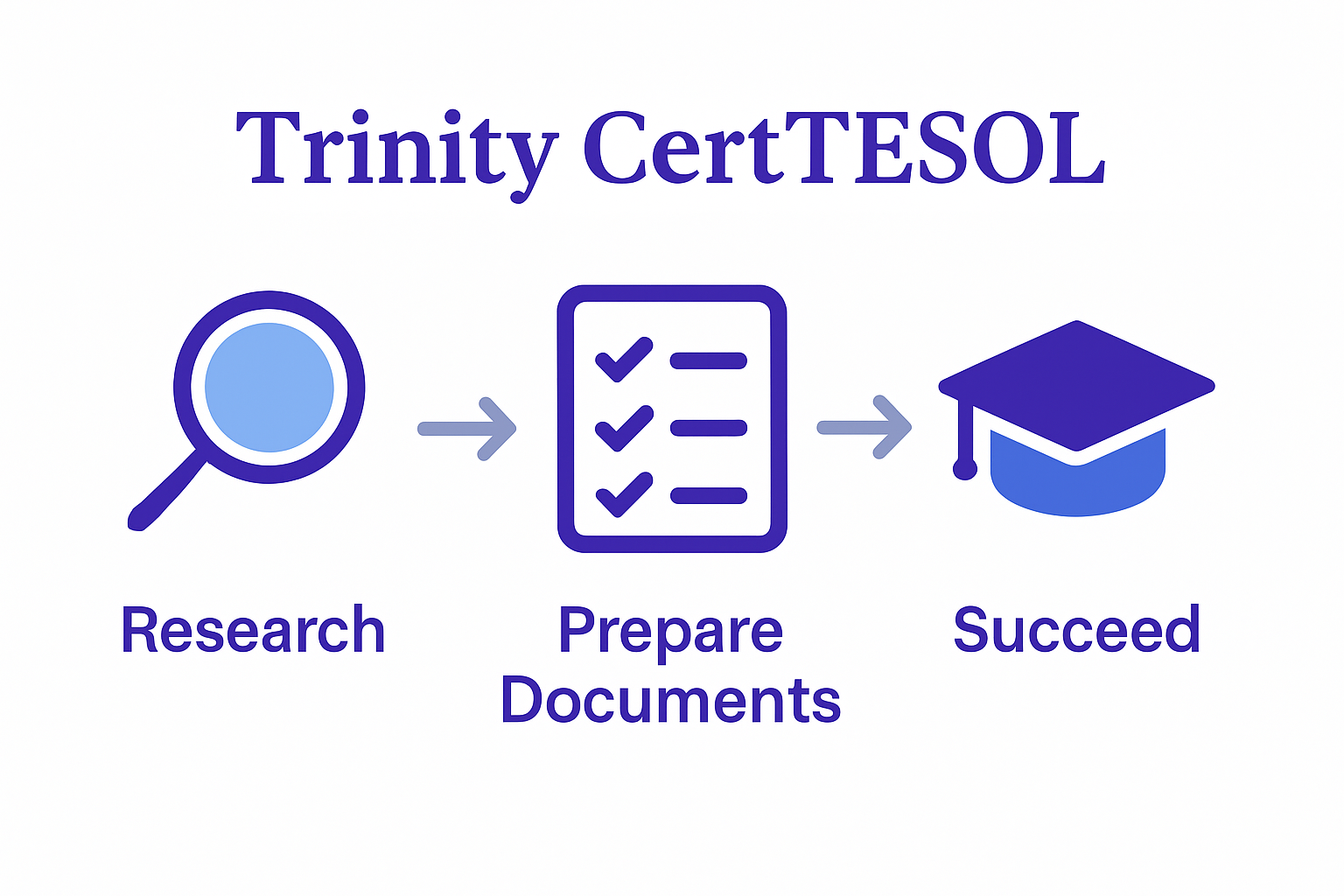
Over 120,000 educators worldwide choose the Trinity CertTESOL as their gateway to international teaching. Whether you are dreaming of classrooms abroad or aiming to boost your language teaching skills at home, understanding each step of the certification process is vital. This guide breaks down the journey into clear and manageable stages so you can meet the requirements confidently and set yourself up for long term success.
Table of Contents
- Stage 1: Research Trinity CertTESOL Requirements
- Stage 2: Evaluate Your Eligibility And Goals
- Stage 3: Gather Essential Application Documents
- Stage 4: Strengthen Your English Language Skills
- Stage 5: Familiarise Yourself With Course Content
- Stage 6: Plan Your Study And Practice Schedule
Quick Summary
| Key Point | Explanation |
|---|---|
| 1. Understand certification requirements | Research Trinity CertTESOL prerequisites including educational qualifications and language proficiency needed for acceptance. |
| 2. Assess your readiness and goals | Conduct a self-evaluation of your skills and aspirations to ensure the programme aligns with your teaching ambitions. |
| 3. Compile essential application documents | Organise all required documents, including transcripts and language proficiency certificates, to create a strong application package. |
| 4. Enhance your English proficiency | Develop your linguistic skills through diverse activities to succeed in the English-intensive teaching certification. |
| 5. Create a structured study plan | Design a personalised schedule that accounts for your commitments while allowing for intensive study and practice in teaching skills. |
Stage 1: Research Trinity CertTESOL requirements
Researching the Trinity CertTESOL requirements is your crucial first step towards launching an exciting international teaching career. This stage involves understanding the academic and professional prerequisites that will set you up for successful certification.
To begin your research, visit the official Trinity College requirements page which provides comprehensive guidance. The primary requirement is possessing educational qualifications equivalent to higher education entry level. This typically means having completed secondary school or holding a comparable academic credential that would permit university admission. For international candidates, this might involve presenting equivalent national qualifications recognised by Trinity College.
Language proficiency is another critical aspect of your research. While the course is delivered in English, Trinity expects candidates to demonstrate strong communication skills. Most training providers will assess your English language capability during the application process, so preparing robust evidence of your linguistic competence is essential. This could include standardised test scores like IELTS or proof of previous academic study conducted entirely in English.
Pro Tip: Contact multiple Trinity CertTESOL training providers to understand their specific entry requirements, as these can vary between institutions.
Your next step after gathering comprehensive research will be preparing a strong application package that showcases your academic background and teaching potential. Understanding these requirements early ensures you can strategically position yourself as an ideal candidate for this internationally recognised teaching qualification.
Stage 2: Evaluate your eligibility and goals
Evaluating your eligibility and goals is a pivotal moment in your Trinity CertTESOL journey. This stage involves honestly assessing your current skills, professional aspirations, and personal readiness for an intensive teaching certification programme.
Start by conducting a comprehensive self assessment of your teaching potential. Your evaluation should include examining your language proficiency, academic background, and motivation for pursuing the Trinity CertTESOL. Detailed certification guides recommend considering factors such as your communication skills, adaptability, cultural sensitivity, and willingness to engage in challenging learning experiences. Consider your career objectives carefully: are you seeking international teaching opportunities, personal professional development, or a complete career transition?
Reflect critically on your professional goals and how the Trinity CertTESOL aligns with them. Some candidates aim to teach abroad in countries like Japan or South Korea, while others seek opportunities in international language schools or online teaching platforms. Your personal motivation will significantly impact your commitment and success throughout the programme.
Pro Tip: Speak with current teachers or programme alumni to gain realistic insights into the course demands and potential career pathways.
Once you have thoroughly evaluated your eligibility and goals, you will be better positioned to make an informed decision about pursuing the Trinity CertTESOL. The next crucial stage involves preparing a strong application that showcases your potential as an exceptional English language educator.
Stage 3: Gather essential application documents
Gathering essential application documents is a critical phase in your Trinity CertTESOL preparation. This stage requires meticulous organisation and attention to detail to ensure a smooth and comprehensive application process.

Begin by compiling a comprehensive application package that showcases your academic and professional credentials. Your document collection should typically include certified copies of your academic transcripts, proof of higher education qualifications, a current passport or national identification document, and an up-to-date curriculum vitae or professional resume. If you have previous teaching experience or relevant professional certifications, include copies of these documents to strengthen your application.
Language proficiency documentation is particularly crucial for international candidates. Prepare official evidence of your English language skills, such as IELTS or TOEFL certificates, academic transcripts from English medium institutions, or professional references that can validate your communication capabilities. Some training providers might require additional supporting documents, so proactively contact your chosen Trinity CertTESOL centre to confirm their specific documentation requirements.
Pro Tip: Create digital and physical copies of all documents, ensuring they are clearly legible and professionally presented.
Once you have gathered and organised your essential application documents, you will be well prepared to submit a compelling application that demonstrates your readiness for the Trinity CertTESOL programme. The next stage involves carefully reviewing and submitting your meticulously compiled application package.
Stage 4: Strengthen your English language skills
Strengthening your English language skills is a fundamental requirement for success in the Trinity CertTESOL programme. This stage focuses on developing comprehensive linguistic capabilities that will prepare you for the intensive language teaching environment.
Begin by exploring targeted language teaching strategies that enhance your communicative competence. Engage in diverse language practice activities such as academic reading, structured writing exercises, podcasts, language exchange platforms, and conversation groups. Pay special attention to refining your pronunciation, expanding vocabulary, and developing nuanced grammatical understanding. Critical areas to focus on include academic discourse, professional communication, and the subtle linguistic variations essential for effective English language instruction.
Dedicate consistent time to immersive language experiences that challenge your current skill level. This might involve watching British documentaries, listening to academic lectures, participating in online language forums, or joining professional development webinars related to English language teaching. Your goal is to develop not just linguistic proficiency, but also the analytical skills necessary to deconstruct language structures and explain them effectively to future students.
Pro Tip: Record yourself speaking and analyse your own language performance to identify areas for improvement.
As you progressively strengthen your English language skills, you will build the confidence and expertise required for the Trinity CertTESOL programme. The next stage involves translating these linguistic skills into effective teaching methodologies and classroom strategies.
Stage 5: Familiarise yourself with course content
Familiarising yourself with the Trinity CertTESOL course content is a crucial step in preparing for this comprehensive teaching certification programme. This stage involves understanding the intricate structure and expectations of each course unit to set yourself up for success.
Comprehensive course guides reveal that the Trinity CertTESOL comprises five distinctive units: Teaching Skills, Language Awareness, Learner Profile, Materials Assignment, and Unknown Language. Each unit demands specific skills and approaches. The Teaching Skills unit will challenge you to develop practical classroom instruction techniques, while the Language Awareness component requires deep grammatical and linguistic understanding. The Learner Profile unit focuses on understanding individual student needs, and the Materials Assignment tests your ability to create engaging educational resources.
Prepare strategically by obtaining sample course materials, connecting with previous course participants, and reviewing recommended preparatory reading. Your approach should be systematic and thorough, recognising that each unit contributes critically to your overall teaching competence. Develop a structured study plan that allows you to explore each unit’s nuances, paying particular attention to the practical teaching components and reflective assessment requirements.
Pro Tip: Create a detailed study schedule that allocates specific time for understanding each course unit and practising associated skills.
As you become increasingly familiar with the course content, you will build confidence and develop a comprehensive understanding of the Trinity CertTESOL programme. The subsequent stage involves translating this theoretical knowledge into practical teaching capabilities.
Stage 6: Plan your study and practice schedule
Planning your study and practice schedule for the Trinity CertTESOL requires strategic thinking and meticulous organisation. This stage is about creating a robust framework that will support your intensive learning journey through the comprehensive teaching certification programme.
Targeted course planning resources highlight that the programme demands a minimum of 130 hours of dedicated study. Depending on your chosen course format full-time, part-time, online, or blended you will need to craft a personalised schedule that accommodates the programme’s rigorous academic and practical requirements. Consider your existing commitments carefully and allocate sufficient time for theoretical study, practical teaching practice, reflective assignments, and personal skill development.
Break down your study schedule into manageable segments that address each course unit systematically. Allocate specific time blocks for Language Awareness research, lesson planning, teaching practice preparation, and reflective journaling. Incorporate regular self assessment periods where you can review your progress, identify learning gaps, and adjust your approach accordingly. Flexibility is key your schedule should be comprehensive yet adaptable to the dynamic nature of teacher training.
Pro Tip: Use digital planning tools or physical planners to track your study progress and maintain accountability throughout the course.
As you develop a structured and personalised study schedule, you will build the foundation for successful completion of the Trinity CertTESOL programme. The next stage involves implementing your carefully crafted study plan and embracing the transformative learning experience ahead.
Take the Next Step Towards Trinity CertTESOL Success
Preparing for the Trinity CertTESOL can feel overwhelming with its rigorous requirements and diverse course units like Language Awareness and Teaching Skills. Many candidates face challenges such as meeting entry prerequisites, organising essential documents, and building a solid study plan while strengthening their English language proficiency. Understanding these hurdles while aligning your professional goals can make all the difference for a confident start.
You do not have to navigate this journey alone. At EBC TEFL Course, we specialise in guiding aspiring teachers through every stage of their Trinity CertTESOL preparation. Our accredited programmes blend practical training with expert support to sharpen your teaching and language skills, ensuring you meet certification standards. Connect with our team today for a personalised consultation and start crafting your ideal study schedule. Whether you seek international opportunities or want to boost your teaching credentials, the time to act is now. Book your free consultation at Get a Free Consultation and transform your ambition into a rewarding global teaching career.
Frequently Asked Questions
What are the academic requirements for the Trinity CertTESOL?
The primary academic requirement is to have qualifications equivalent to higher education entry level, such as completing secondary school. To prepare, review your educational background and ensure you have certified documents ready for submission.
How can I demonstrate my English language proficiency for the Trinity CertTESOL application?
You can demonstrate your English proficiency through recognised tests such as IELTS or by providing evidence of previous study in English. Collect your test scores or academic records to include in your application package.
What documents do I need to gather for my Trinity CertTESOL application?
You will need to compile certified copies of your academic transcripts, proof of higher education qualifications, a valid passport or national ID, and a current CV. Begin organising these documents well ahead of your application deadline to avoid any last-minute issues.
How can I effectively strengthen my English language skills before starting the course?
To strengthen your English, engage in various language activities, including conversation groups and academic writing exercises. Dedicate at least a few hours each week to practice these skills, focusing on areas like pronunciation and vocabulary expansion.
What should I include in my study and practice schedule for the Trinity CertTESOL?
Your study schedule should include time for theoretical study, practical teaching preparation, and reflection on your learning. Break down your 130 hours of study into manageable sessions, such as dedicating two hours daily to lesson planning and practice.
How can I prepare for each unit of the Trinity CertTESOL course effectively?
Familiarise yourself with each of the five course units by obtaining sample materials and creating a detailed study plan. Allocate specific study blocks for each unit and set aside time each week to review and practice course content.
Recommended
- 7 Key Advantages of the Trinity CertTESOL for Aspiring Teachers – EBC TEFL courses
- Step-by-Step Guide to Trinity CertTESOL Certification – EBC Trinity CertTESOL and TEFL courses
- How to pass the Trinity CertTESOL – a step by step guide
- Complete Guide to Trinity CertTESOL Certification – EBC Trinity CertTESOL and TEFL courses