

Last updated: October 28, 2026
Preparing for a TEFL job involves more than practising interview answers. You also need to research employers, understand the requirements of your preferred destinations, organise your professional documents and present your teaching skills effectively.
This guide focuses on those practical preparations. It will help you compare TEFL training programmes, investigate international job markets, assemble a teaching portfolio and check the details of an application before an interview.
If you want advice on interview questions and how to present yourself to an employer, read our companion guides: All You Need to Know for a TEFL Job Interview – Part 1 and Part 2.
Table of Contents
- Research TEFL Qualifications and Job Markets
- Investigate Employers and Job Requirements
- Organise Your Documents and Teaching Portfolio
- Prepare Practical Teaching Materials
- Check Application Details and Interview Logistics
- Turn Your Preparation into a Strong Application
- Frequently Asked Questions
- Recommended Reading
Research TEFL Qualifications and Job Markets
Before applying for teaching positions, investigate the qualifications employers expect and the requirements that apply in your preferred destinations. These checks can help you focus your job search and identify any gaps in your preparation.
Understand what makes a TEFL qualification recognised
Not all TEFL courses offer the same level of training or assessment. When comparing programmes, look beyond the course title and examine the qualification awarded, the practical teaching component, the assessment process and the organisation responsible for the award.
Our guide to TEFL course accreditation explains what to consider when evaluating a programme.
Trinity College London’s CertTESOL is an established initial teacher-training qualification. When researching courses, check the awarding body’s information and the specific requirements of the employers or institutions you hope to approach.
Compare programmes using practical criteria:
- Course content: Does the programme cover lesson planning, language awareness, teaching methodology and classroom management?
- Teaching practice: Does it include assessed teaching practice with learners?
- Assessment: How does the course assess your developing teaching skills?
- Qualification: What certificate or qualification will you receive?
- Career support: Does the provider offer job-search guidance or placement assistance?
Compare these features before committing to a course. A qualification that meets your target employers’ requirements and gives you practical teaching experience can provide a stronger foundation for your job search.
Research your preferred teaching destinations
Once you understand the qualification requirements, investigate the countries and cities where you would like to teach. Employment conditions can vary considerably between destinations and between individual employers within the same country.
Research the following points for each destination:
- Qualifications and experience employers typically request.
- Visa, work authorisation and residency requirements that apply to your circumstances.
- Typical salaries, working hours and cost of living.
- Contract terms, including paid holidays, preparation time and any benefits.
- The age groups and learner types you would prefer to teach.
- Local expectations concerning teaching methods and workplace communication.
Use current job advertisements, official government information and reputable recruitment sources to check the details. Speak to teachers who work in your preferred destination if you can, and ask about their experiences with employers and working conditions.
Do not rely on a salary figure alone when comparing opportunities. Consider the number of teaching hours, preparation time, housing costs, transport, taxes and other expenses. These factors will help you judge whether a position is financially suitable.
Compare potential destinations
The table below provides a framework for researching some popular TEFL destinations. It is not a statement of current salaries, visa eligibility or uniform teaching cultures. Requirements and employment conditions depend on the employer, the role and your personal circumstances.
| Destination | What to investigate | Where to focus your research |
|---|---|---|
| Spain | Qualifications, work authorisation, salaries and contract terms. | Language schools, private academies and other teaching employers. |
| France | Recruitment routes, eligibility requirements, pay and working hours. | Language schools, educational institutions and relevant assistant programmes. |
| Italy | Employer requirements, work authorisation and living costs. | Language schools and other organisations recruiting English teachers. |
| Japan | Qualification requirements, visa eligibility, contract conditions and benefits. | Language schools and other established teaching programmes. |
| South Korea | Eligibility, visa requirements, salary, accommodation and working hours. | Language schools and other teaching employers with clearly stated conditions. |
Build your own comparison using current information from employers and official sources. This will give you a more reliable basis for choosing where to apply than broad country-level generalisations.
Investigate Employers and Job Requirements
After choosing your preferred destinations, research individual schools and employers. Two organisations in the same city may have different recruitment criteria, teaching approaches and working conditions.
Start with the employer’s website
Read the school’s website carefully. Look for its student profile, course offerings, teaching approach, location and recruitment information. Check whether the school teaches children, teenagers, adults or business professionals.
Use this information to assess whether your qualifications and interests match the position. If the school specialises in Business English, for example, consider how your training or previous professional experience could support that work.
Review the employer’s social media pages as well. They may provide additional information about school activities, student events and the working environment.
Read job advertisements carefully
Before applying, separate essential requirements from desirable skills. An advertisement may specify a particular qualification, teaching experience, language ability, availability or legal right to work in the destination.
Check the details rather than assuming that the requirements are the same everywhere. If an advertisement is unclear, ask the employer for clarification before committing to the application.
It is also worth checking the proposed working conditions. Find out about teaching hours, class sizes, preparation time, salary, holidays, contract duration and any additional responsibilities. These details will help you compare offers and decide whether a role suits your needs.
Prepare questions about the employer
Research should help you make an informed decision, not just persuade an employer to hire you. Prepare questions about any details you cannot confirm from the school’s website or job advertisement.
For further guidance, read our article on questions to ask during a TEFL job interview. It covers practical matters to consider when evaluating a teaching position.
Approach each application with a clear understanding of the role. This will help you explain why you are interested in that particular school and identify any issues that need clarification.
Organise Your Documents and Teaching Portfolio
A well-organised set of professional documents makes it easier to respond to employers’ requests and demonstrate your preparation. A teaching portfolio can also help you present examples of your work during an application or interview.

Gather your essential documents
Start by checking which documents each employer requests. Depending on the position and destination, you may need some or all of the following:
- Your CV or résumé.
- Your TEFL qualification and relevant academic certificates.
- Evidence of previous teaching or other relevant experience.
- References or professional evaluations, where requested.
- Lesson plans or samples of teaching materials.
- Identification and work-authorisation documents, where required.
Keep digital copies organised and make sure the files are readable. Use clear file names so you can find the right document quickly when an employer requests it.
Do not send sensitive personal documents indiscriminately. Follow the employer’s application instructions and use an appropriate, secure method when sharing confidential information.
Build a useful teaching portfolio
Your portfolio should show how you approach teaching and plan learning activities. It does not need to be long. Select examples that demonstrate different skills and explain why each item is relevant.
Useful items may include:
- Teaching certificate: Evidence of your completed qualification.
- Lesson plans: Examples that show how you set aims, sequence activities and check learning.
- Teaching materials: Worksheets, activities or resources you have developed or adapted.
- Feedback: Relevant comments from tutors, mentors or professional observations.
- Reflective notes: Short explanations of what you learned from a lesson and what you would change next time.
Choose material that demonstrates your skills rather than including every document you have. A clear explanation of your decisions can be as useful as the document itself.
Consider a digital portfolio
A digital portfolio can make your materials easier to organise, update and share. You might use a structured folder or a professional website, depending on the type of application and the employer’s preferences.
This guide to creating a digital teaching portfolio offers additional ideas for presenting your work.
You can also review these teaching portfolio examples for inspiration when deciding how to organise your materials.
Remember to protect students’ privacy. Remove identifying information from student work and feedback unless you have appropriate permission to share it. Check that any materials you include are yours to use and distribute.
Choose examples that demonstrate your skills
The table below summarises possible portfolio items and what they can demonstrate to an employer.
| Portfolio item | What it demonstrates | Example |
|---|---|---|
| Teaching certificate | Your completed training and qualification. | A Trinity CertTESOL TEFL course certificate. |
| Lesson plan | Your ability to set aims and structure a lesson. | A lesson that practises a grammar point. |
| Teaching material | Your ability to select or develop appropriate learning resources. | A worksheet or communicative activity. |
| Observation feedback | Your strengths and areas for development. | Feedback from a tutor or teaching-practice observer. |
Review your portfolio before each application. Adjust the examples to the role where appropriate, but keep the information accurate and be ready to explain your contribution to any work you present.
Prepare Practical Teaching Materials
Some employers ask candidates to demonstrate their teaching skills or explain how they would handle a classroom situation. Preparing a small selection of materials can help you respond to these requests more confidently.
Prepare adaptable lesson examples
Choose a lesson plan or activity that you understand well. Be ready to explain the learning aims, the learners’ likely needs, the sequence of activities and how you would check understanding.
Think about how you would adapt the activity for learners with different levels of English. You might simplify instructions, provide examples, add visual support or extend the task for learners who finish early.
It is also useful to practise explaining a language point clearly. Choose an example that lets you demonstrate how you would clarify meaning, form and pronunciation, and then give learners an opportunity to use the language.
Practise classroom scenarios
Roleplay can help you prepare for situations that may arise during a teaching demonstration or interview. Consider how you would respond if a learner struggled to understand instructions, lost interest in an activity or needed additional support.
These roleplay activities for English learners can provide ideas for classroom practice.
You can also review these roleplay scenarios for examples of interpersonal communication situations.
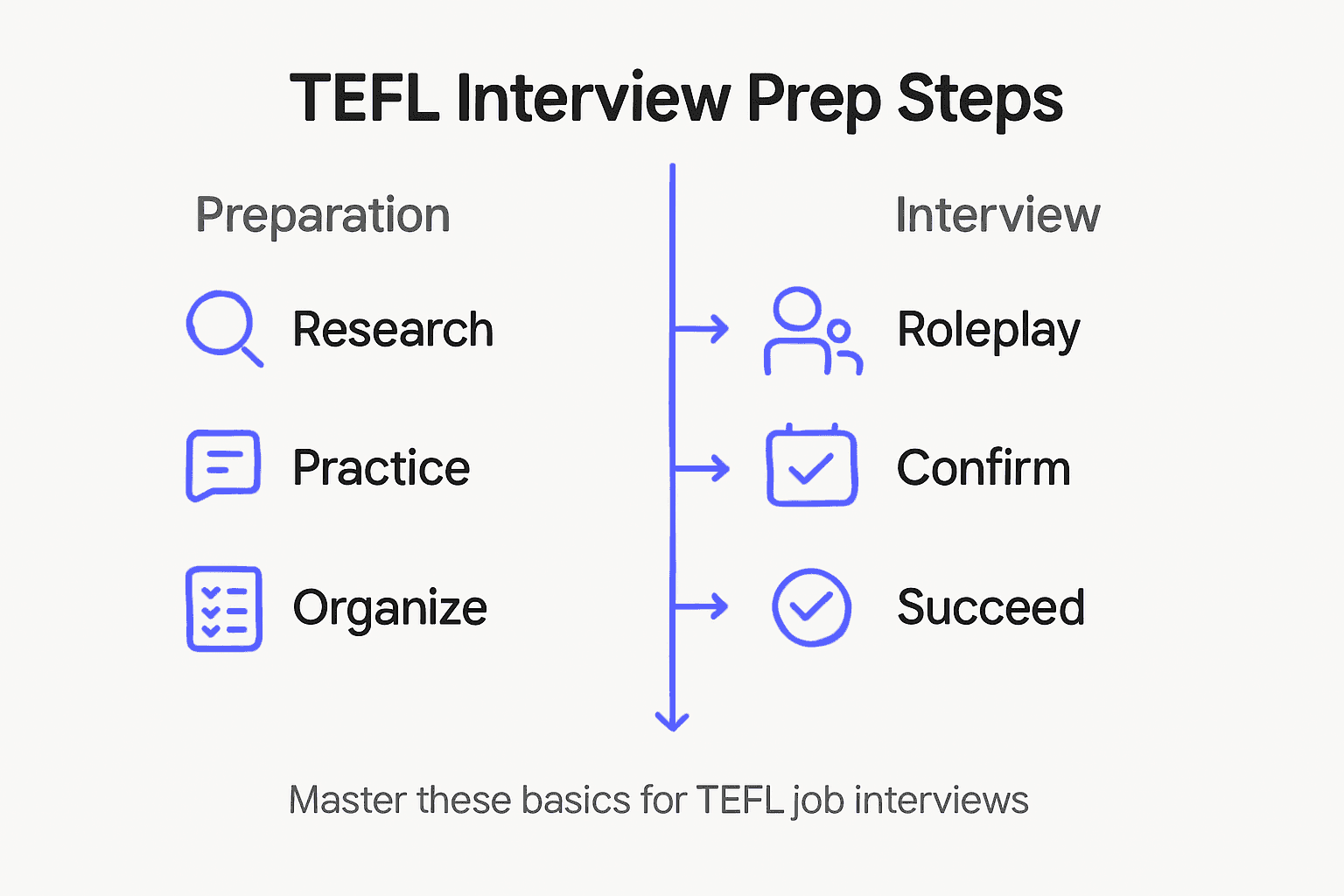
Practise explaining your decisions aloud. Focus on why you would choose a particular activity, how you would involve learners and what you would do if the lesson did not go as planned.
If possible, ask an experienced teacher or mentor to review your lesson plan or observe a practice demonstration. Specific feedback can help you identify unclear instructions, unrealistic timings or activities that need adjustment.
Keep interview-question preparation separate
Teaching materials are one part of interview preparation, but you should also practise answering questions about your teaching approach and experience. Rather than covering those questions in detail here, use the dedicated guides in our interview series:
This approach lets you prepare your documents and materials alongside your interview answers without treating them as the same task.
Check Application Details and Interview Logistics
Before an interview, review the practical details that could affect your application or your ability to attend. A short checklist can help you avoid preventable last-minute problems.
Confirm the interview arrangements
Check the date, time, location and format of the interview. If it will take place online, confirm which platform the employer plans to use and whether you need to install software or create an account.
For an international interview, confirm the time zone as well. State the city and country when agreeing on a time so that both parties understand the arrangement.
Prepare for an online interview
Test your internet connection, camera, microphone and chosen platform before the appointment. Choose a quiet space with suitable lighting and a background that will not distract the interviewer.
Keep your CV, portfolio and any requested documents within easy reach. Close unnecessary applications and notifications so that they do not interrupt the conversation.
If the connection fails, have a suitable backup option available, such as a telephone number or an alternative way to contact the interviewer.
Plan for an in-person interview
Check the route and allow time for possible delays. Confirm the address and any instructions about reception, entry or required identification.
Choose professional clothing that suits the employer’s working environment. Prepare the documents requested in advance and keep them organised so you can find them quickly.
Complete a final application check
Before attending, review the job description and your application. Make sure your contact details are correct and that you can discuss the qualifications, skills and experience listed in your CV.
Use this final checklist:
- Confirm the interview date, time and format.
- Review the employer’s website and job description.
- Prepare the documents the employer requested.
- Check your CV and portfolio for errors or outdated information.
- Test your equipment if the interview is online.
- Plan your route if the interview is in person.
- Keep the employer’s contact details available in case arrangements change.
Store copies of important documents securely. Only share identification or other sensitive information when the employer has a legitimate need for it and provides an appropriate way to submit it.
Turn Your Preparation into a Strong Application
Good preparation helps you make informed decisions about where to apply and how to present your skills. Research your qualification options, investigate employers, check the requirements of your preferred destinations and organise examples of your teaching practice.
If you are considering professional TEFL training, EBC offers Trinity College London-accredited courses, including the Trinity CertTESOL, as well as teacher-development options. You can explore our TEFL certification courses to learn more about the training available.
EBC also offers lifetime worldwide job-placement assistance to graduates. This support can help you navigate your job search, although individual employers make their own recruitment decisions.
For those considering a longer study-abroad experience, EBC offers programmes in Spain, France and Italy that combine teacher training with further study. Check the current programme details, eligibility criteria and applicable visa requirements before making plans.
Explore the available options and discuss your goals with the EBC team to decide which route best suits your circumstances.
Ready to discuss your options? Book a free consultation with EBC TEFL to learn more about the courses, study-abroad options and career support available.
Frequently Asked Questions
How can I prepare for common TEFL interview questions?
Read the job description and research the employer before practising your answers. Prepare specific examples that demonstrate your teaching approach, problem-solving skills and ability to adapt. For more detailed guidance, read Part 1 of our TEFL interview guide and Part 2.
What should I include in my TEFL teaching portfolio?
Start with your teaching qualification, lesson plans and relevant teaching materials. You can also include appropriate observation feedback and reflective notes. Choose examples that demonstrate your skills and protect any confidential or identifying student information.
How do I practise roleplay scenarios for a TEFL interview?
Practise explaining language, giving instructions and responding to realistic classroom situations. Ask a colleague, mentor or experienced teacher to observe your practice and give you specific feedback.
What should I check before a TEFL job interview?
Confirm the date, time, location and interview format. Review the job description, prepare the requested documents and check your equipment if the interview is online. For international appointments, confirm the time zone and the local time at both locations.
How can I demonstrate cultural adaptability?
Prepare honest examples of times when you adapted your communication, worked with people from different backgrounds or responded constructively to unfamiliar situations. Research the destination and employer, but avoid making assumptions about individuals based on their nationality or culture.
What should I do if I feel unprepared?
Focus first on the essentials: review the job description, research the employer, organise your documents and practise explaining your relevant skills. Ask a mentor or experienced teacher for feedback if possible. Break the preparation into manageable tasks rather than trying to cover everything at once.