
The importance of tefl accreditation – Over 80 percent of employers worldwide prefer candidates with accredited TEFL certification, especially the Trinity CertTESOL and CELTA, when hiring English teachers. With so many programs available, understanding what TEFL accreditation really means can make all the difference for your teaching career. Learning how proper accreditation works and what it offers helps you avoid costly mistakes and gives you the confidence to pursue high-quality teaching positions across the globe.
Table of Contents
- Defining TEFL Accreditation and Its Purpose
- Recognized TEFL Accrediting Bodies
- How TEFL Accreditation Works
- Benefits of Accredited TEFL Certification
- Spotting Fraudulent Accreditation
Key Takeaways
| Point | Details |
|---|---|
| Importance of TEFL Accreditation | TEFL accreditation validates educators’ teaching capabilities and enhances their marketability in international education. |
| Role of Accrediting Bodies | Prestigious organizations ensure quality training and standards in TEFL certification, impacting employment opportunities. |
| Components of Accreditation | The process assesses theoretical knowledge, practical skills, and cultural competency through rigorous training and evaluations. |
| Avoiding Fraudulent Accreditation | Candidates must research and verify institutions’ credentials to avoid illegitimate certifications that can hinder their careers. |
Defining TEFL Accreditation and Its Purpose
TEFL accreditation represents a professional certification process that validates an individual’s ability to teach English as a foreign language. Accreditation serves as a critical benchmark for quality teaching standards, ensuring educators possess the necessary skills, knowledge, and pedagogical techniques required to effectively instruct non-native English speakers across diverse learning environments, as outlined in an accredited TEFL checklist.
At its core, TEFL accreditation evaluates an educator’s comprehensive understanding of language teaching methodologies, classroom management strategies, and cross-cultural communication skills. Professional bodies like types of accredited TEFL courses examine candidates through rigorous training programmes that assess practical teaching competencies, theoretical language understanding, and adaptable instructional approaches.
The purpose of TEFL accreditation extends far beyond mere certification. It provides aspiring educators with a structured pathway to international teaching opportunities, demonstrating to potential employers a standardised level of professional preparation. Key benefits of obtaining an accredited TEFL certification include:
- Global recognition of teaching credentials
- Enhanced employability in international education markets
- Comprehensive training in modern language instruction techniques
- Practical classroom management skills
- Understanding of diverse learning environments
Professional accreditation transforms theoretical knowledge into practical teaching expertise. By completing an internationally recognised programme, teachers gain not just a certificate, but a passport to meaningful cross-cultural educational experiences worldwide. The right accreditation can open doors to teaching positions in countries ranging from Japan to Spain, providing a solid foundation for a rewarding global teaching career.
Recognized TEFL Accrediting Bodies
The landscape of TEFL accreditation involves several prestigious international bodies that establish and maintain rigorous standards for English language teaching qualifications. These organisations play a critical role in ensuring educators receive comprehensive, high-quality training that meets global educational benchmarks. Which TEFL course is most recognised provides deeper insights into the nuanced world of professional certification.
Two internationally respected organisations set the benchmark for quality in English language teaching qualifications: Trinity College London and Cambridge English. Both institutions are widely recognised for their rigorous standards and long-standing contributions to the global TEFL profession.
They typically evaluate and validate teacher training programmes using several key criteria:
- Comprehensive curriculum design
- Instructor qualifications
- Student learning outcomes
- Programme assessment methods
- Institutional support and resources
International recognition means more than just a certificate. For aspiring English language teachers, an accreditation from a respected body signals professional credibility, demonstrating to potential employers that the candidate has undergone rigorous, standardised training. This recognition can be the difference between securing an international teaching position and being overlooked in a competitive global job market.
How TEFL Accreditation Works
TEFL accreditation is a comprehensive process that transforms aspiring educators into qualified English language instructors through a structured, rigorous evaluation system. The journey involves multiple stages designed to assess and develop critical teaching competencies across theoretical knowledge, practical skills, and cross-cultural communication abilities. Understanding different TEFL certifications helps candidates navigate this intricate professional pathway.
The accreditation process typically unfolds through several key stages. Initially, candidates undergo extensive training programmes that cover language teaching methodologies, classroom management techniques, and pedagogical strategies. These programmes include both theoretical coursework and practical teaching components, where participants demonstrate their ability to design lessons, manage student interactions, and adapt to diverse learning environments. Assessments are comprehensive, involving written examinations, lesson planning exercises, observed teaching practicums, and reflective teaching portfolios.
Critical components of the TEFL accreditation process include:
- Comprehensive theoretical training
- Practical teaching demonstrations
- Peer and expert evaluations
- Language proficiency assessments
- Cultural competency examinations
Successful accreditation requires candidates to meet stringent professional standards. This means not just passing examinations, but demonstrating a holistic understanding of language education. Accrediting bodies meticulously review each candidate’s ability to create inclusive, engaging learning experiences that go beyond simple language instruction. The ultimate goal is to produce educators who can effectively bridge linguistic and cultural gaps, transforming language learning from a technical exercise into a meaningful intercultural exchange.
Benefits of Accredited TEFL Certification
International recognition transforms a simple teaching qualification into a powerful professional credential that opens doors to global career opportunities. An accredited TEFL certification represents far more than a piece of paper – it’s a comprehensive passport to professional teaching experiences across diverse educational landscapes. Exploring international TEFL opportunities reveals the profound impact a recognised certification can have on an educator’s career trajectory.
The benefits of an accredited TEFL certification extend well beyond basic employability. Professional educators gain a robust skill set that encompasses advanced pedagogical techniques, cross-cultural communication strategies, and adaptive teaching methodologies. These qualifications demonstrate to potential employers a commitment to educational excellence, showing that the certificate holder has undergone rigorous training and possesses the nuanced skills required to effectively teach English in complex, multicultural learning environments.
Key advantages of obtaining an accredited TEFL certification include:
- Enhanced global job marketability
- Higher potential earning opportunities
- Comprehensive professional training
- Credibility with international schools and language centres
- Advanced classroom management skills
- Deeper understanding of language acquisition theories
Moreover, an accredited certification provides teachers with a competitive edge in an increasingly globalised education sector. It signals not just language proficiency, but a sophisticated understanding of educational principles, learning psychology, and intercultural communication. By investing in a recognised TEFL qualification, educators are essentially investing in their own professional development, creating pathways to meaningful teaching experiences that transcend geographical and cultural boundaries.
Spotting Fraudulent Accreditation
Navigating the complex world of TEFL certification requires a keen eye and careful research to avoid falling victim to fraudulent or substandard accreditation programmes. Unscrupulous providers often create certificates that look legitimate but offer little real-world value, potentially derailing an aspiring educator’s international teaching career. Understanding different TEFL certifications can help you distinguish between genuine and counterfeit qualifications.
Fraudulent accreditation often exhibits several telltale warning signs that sophisticated candidates can quickly identify. These typically include unrealistically short course durations, extremely low pricing, lack of verifiable contact information, absence of recognised professional affiliations, and certificates that cannot be independently verified through official channels. Legitimate accreditation bodies maintain transparent processes, provide detailed curriculum information, and offer clear pathways for professional verification of their credentials.
Key red flags that signal potentially fraudulent accreditation include:
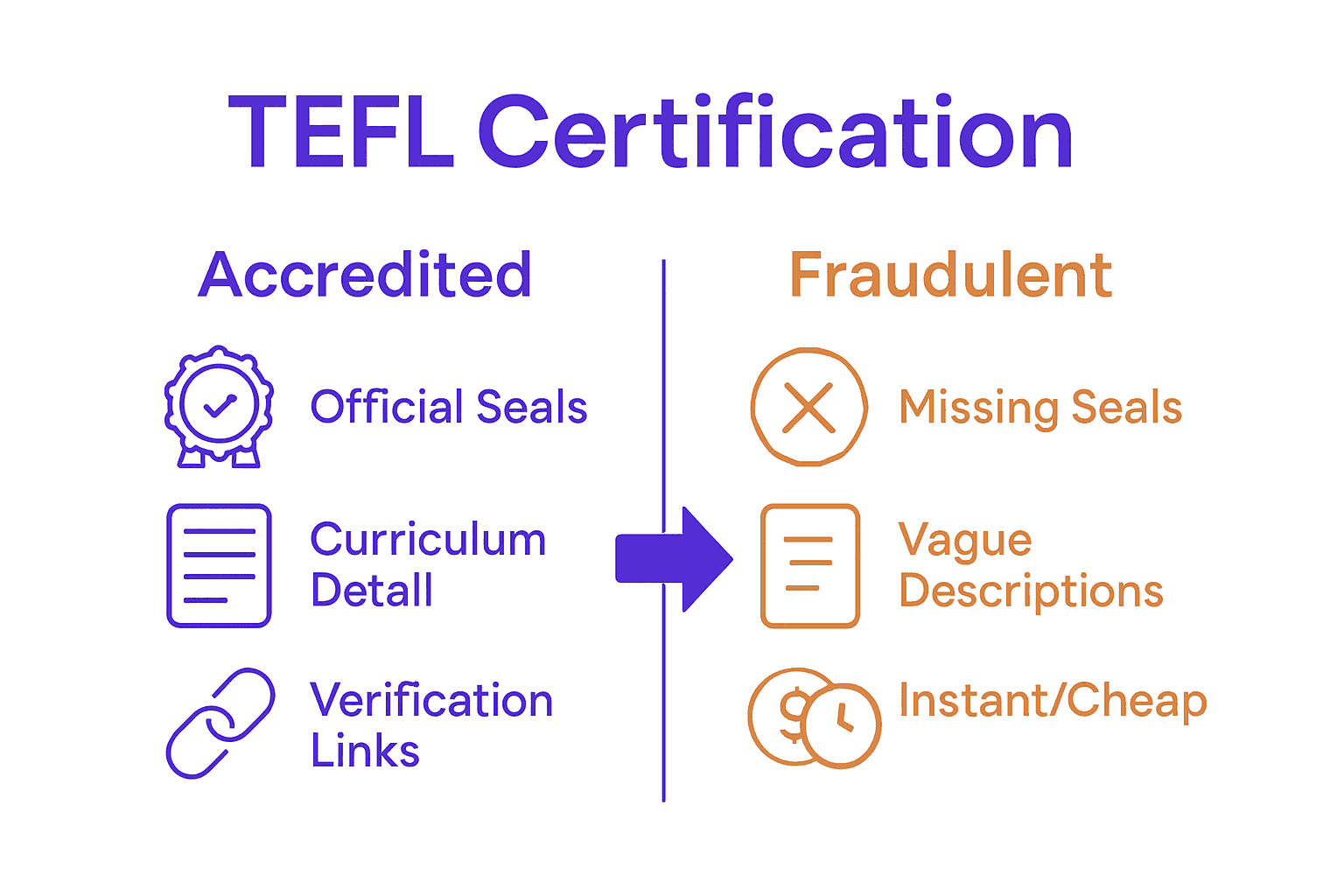
- Certificates available with minimal or no coursework
- Promises of instant certification
- Pricing significantly lower than industry standards
- Lack of detailed course curriculum
- No verifiable professional affiliations
- Websites with poor design and numerous grammatical errors
- Inability to provide concrete graduate employment statistics
Protecting yourself requires diligence and thorough research. Prospective TEFL candidates should always verify an institution’s credentials, check professional registrations, contact accrediting bodies directly, and seek recommendations from established international teaching networks.
 A legitimate TEFL certification is an investment in your professional future – taking time to ensure its authenticity is crucial to maintaining your career credibility and professional reputation.
Secure Your Future with Trusted TEFL Accreditation
Navigating the world of TEFL accreditation can feel overwhelming, especially with the risk of fraudulent certificates and unclear course quality. This article highlights the essential need for recognised accreditation and practical training that truly prepare you for international teaching roles. If your goal is to gain globally recognised credentials, develop real classroom skills, and access genuine international job opportunities, it is vital to choose a course backed by reputable accreditation like Trinity College London.
At EBC TEFL Course, we understand these challenges and offer accredited TEFL and TESOL certifications designed to meet rigorous professional standards. We provide comprehensive training including practical teaching, specialised pathways such as business English and online teaching, and ongoing support to help you land the international position you deserve. Don’t risk your career on uncertified providers or quick fixes. Discover how we can help you unlock your teaching potential by booking a free consultation today at Book a Call. Start your journey with confidence and ensure your certification stands out worldwide.
Frequently Asked Questions
What is TEFL accreditation?
TEFL accreditation is a professional certification process that verifies an individual’s ability to teach English as a foreign language, ensuring they meet established teaching quality standards.
Why is TEFL accreditation important for teachers?
TEFL accreditation is crucial as it provides global recognition of teaching credentials, enhances employability, and equips educators with the skills necessary to effectively teach English in diverse environments.
How does the TEFL accreditation process work?
The TEFL accreditation process involves rigorous training that includes theoretical coursework, practical teaching demonstrations, assessments, and evaluations to ensure that candidates meet high professional standards.
What should I look for to avoid fraudulent TEFL accreditation?
To avoid fraudulent accreditation, watch for red flags such as unrealistically short courses, prices significantly lower than industry standards, lack of detailed curriculum, and absence of recognized professional affiliations.
Recommended
- 7 Key Types of Accredited TEFL Courses Explained – EBC Trinity CertTESOL and TEFL courses
- Teaching IELTS, everything you need to know – EBC Trinity CertTESOL and TEFL courses
- TESOL, TEFL, CELTA, DELTA, TESL – How Are They Different? – EBC Trinity CertTESOL and TEFL courses
- TESOL Certification Steps: Guide to Global English Teaching – EBC Trinity CertTESOL and TEFL courses