
Starting your teaching journey means facing new classrooms, unfamiliar faces, and the need for real confidence. Many aspiring English teachers soon realise that lectures alone do not prepare them for lively European classrooms or cultural exchange. By embracing peer teaching in English education, you gain hands-on experience, refine communication skills, and build connections with fellow trainees—all while practising in safe, supportive environments relevant to your future job market.
Table of Contents
- Peer Teaching Defined in English Education
- Different Models and Approaches to Peer Teaching
- How Peer Teaching Works in TEFL Training
- Key Benefits for Teachers and Learners
- Essential Skills and Requirements for Success
- Peer Teaching in EBC’s 1-Year Abroad Programmes
Key Takeaways
| Point | Details |
|---|---|
| Peer Teaching Enhances Learning | This collaborative approach fosters engagement, autonomy, and confidence in language production among students. |
| Diverse Teaching Models | Various models such as Peer Tutoring and Cooperative Learning cater to different learning needs and objectives. |
| Critical Skills Development | Successful peer teaching requires strong communication, active listening, and adaptability to promote an effective learning environment. |
| Integrated Programmes | EBC’s one-year abroad programmes leverage peer teaching to provide comprehensive language education and cultural immersion. |
Peer Teaching Defined in English Education
Peer teaching represents a dynamic and collaborative educational approach where students actively participate in knowledge exchange, transforming traditional learning hierarchies. In English language education, this method enables learners to become both instructors and recipients of information, creating a mutually beneficial learning environment.
The core concept involves students teaching and learning collaboratively through structured interactions. This approach offers multiple significant advantages:
- Enhances student engagement
- Promotes autonomous learning skills
- Develops communication competencies
- Increases understanding through reciprocal teaching
- Builds confidence in language production
Pedagogical Benefits emerge from this interactive teaching strategy. Students who engage in peer teaching demonstrate improved comprehension, as explaining concepts reinforces their own understanding. Peer teaching creates a non-hierarchical learning environment where students feel more comfortable experimenting with language skills.
Successful peer teaching requires careful preparation and structured guidance from educators. Participants must possess solid foundational knowledge and receive clear instructions about their teaching roles. Effective implementation involves selecting appropriate topics, establishing clear learning objectives, and providing supportive supervision.
Pro tip: When designing peer teaching activities, focus on creating structured scenarios that allow students to demonstrate their language skills while supporting their peers’ learning journey.
Different Models and Approaches to Peer Teaching
Peer teaching encompasses a diverse range of instructional strategies designed to facilitate collaborative learning and knowledge transfer in educational settings. Peer teaching models vary significantly in structure, methodology, and intended learning outcomes, offering educators multiple approaches to engage students actively in the learning process.
The primary peer teaching models include:
- Peer Tutoring: One-to-one support where more experienced students guide peers
- Reciprocal Teaching: Students alternate roles of teacher and learner
- Peer Mentoring: Advanced students provide guidance and support
- Microteaching: Short, focused teaching sessions among peers
- Cooperative Learning: Small groups working collaboratively towards shared goals
- Collaborative Learning: Joint problem-solving and knowledge construction
Structural Dynamics play a crucial role in these approaches. Peer teaching strategies shift instructional focus from traditional teacher-led methods to student-centred interactions, encouraging active participation and critical thinking.
Each model offers unique benefits and requires specific implementation strategies. Peer tutoring, for instance, provides personalised support, while cooperative learning develops teamwork and communication skills. Educators must carefully select and structure these approaches to match learning objectives and student capabilities.
Here is a comparison of the main peer teaching models in English education:
| Model | Structure | Focus Area | Typical Outcome |
|---|---|---|---|
| Peer Tutoring | One-to-one | Targeted support | Improved individual performance |
| Reciprocal Teaching | Alternating roles | Comprehensive skills | Enhanced understanding for all |
| Peer Mentoring | Senior to junior | Guidance and advice | Greater learner autonomy |
| Microteaching | Short sessions | Specific skills | Refined teaching techniques |
| Cooperative Learning | Small groups | Teamwork and solutions | Stronger collaborative ability |
| Collaborative Learning | Group knowledge | Joint problem-solving | Broader critical thinking skills |
Pro tip: When implementing peer teaching models, start with clear guidelines, establish specific learning goals, and provide ongoing support to ensure effective knowledge transfer and student engagement.
How Peer Teaching Works in TEFL Training
Peer teaching in TEFL training represents a sophisticated instructional approach that transforms traditional language learning dynamics. Structured peer-led activities enable language learners to actively participate in their educational journey, developing both linguistic skills and teaching competencies simultaneously.
The core mechanism of peer teaching in TEFL involves several key stages:
- Preparation Stage: Students research and plan lesson content
- Lesson Execution: Peers deliver short teaching sessions
- Interactive Feedback: Participants provide constructive critiques
- Reflection Phase: Learners analyse their performance and learning outcomes
Interaction Dynamics play a critical role in this process. Participants alternate between teacher and student roles, creating a dynamic learning environment that encourages mutual support, critical thinking, and practical language application.

These peer teaching interactions go beyond simple knowledge transfer. They develop essential professional skills such as communication, presentation abilities, and instructional techniques. By experiencing both teaching and learning perspectives, TEFL trainees gain deeper insights into language instruction methodologies and learner experiences.
Pro tip: When participating in peer teaching, approach each session with curiosity, openness to feedback, and a commitment to collaborative learning.
Key Benefits for Teachers and Learners
Peer teaching creates a transformative learning environment that offers substantial advantages for both teachers and learners in English language education. Collaborative learning strategies provide a dynamic approach to language acquisition and skill development.
Benefits for peer teachers include:
- Enhanced communication abilities
- Deeper understanding of language concepts
- Increased self-confidence
- Advanced presentation skills
- Improved critical thinking capabilities
- Practical teaching experience
Learner Advantages emerge through this interactive methodology. Participants experience a supportive, less intimidating learning environment where knowledge exchange occurs naturally. Peer interactions reduce learning anxiety and create opportunities for more authentic language practice.
The reciprocal nature of peer teaching means participants simultaneously develop multiple professional skills. By alternating between teaching and learning roles, individuals gain comprehensive insights into language instruction, communication strategies, and collaborative learning techniques.
Pro tip: Approach peer teaching with an open mindset, viewing each interaction as an opportunity for mutual growth and skill development.
Essential Skills and Requirements for Success
Peer teaching in TEFL requires a sophisticated skill set that goes beyond traditional language learning capabilities. Developing instructional competencies demands deliberate practice and self-reflection from aspiring language educators.
Critical skills for successful peer teaching include:
- Communication Clarity: Ability to explain complex language concepts
- Active Listening: Understanding peer perspectives and learning needs
- Constructive Feedback: Providing supportive and actionable suggestions
- Adaptability: Modifying teaching approaches based on peer responses
- Emotional Intelligence: Managing group dynamics sensitively
- Language Proficiency: Strong command of English grammar and usage
Technical Competencies represent another crucial dimension of effective peer teaching. Participants must develop robust instructional techniques that enable them to create engaging, interactive learning experiences while maintaining professional boundaries.
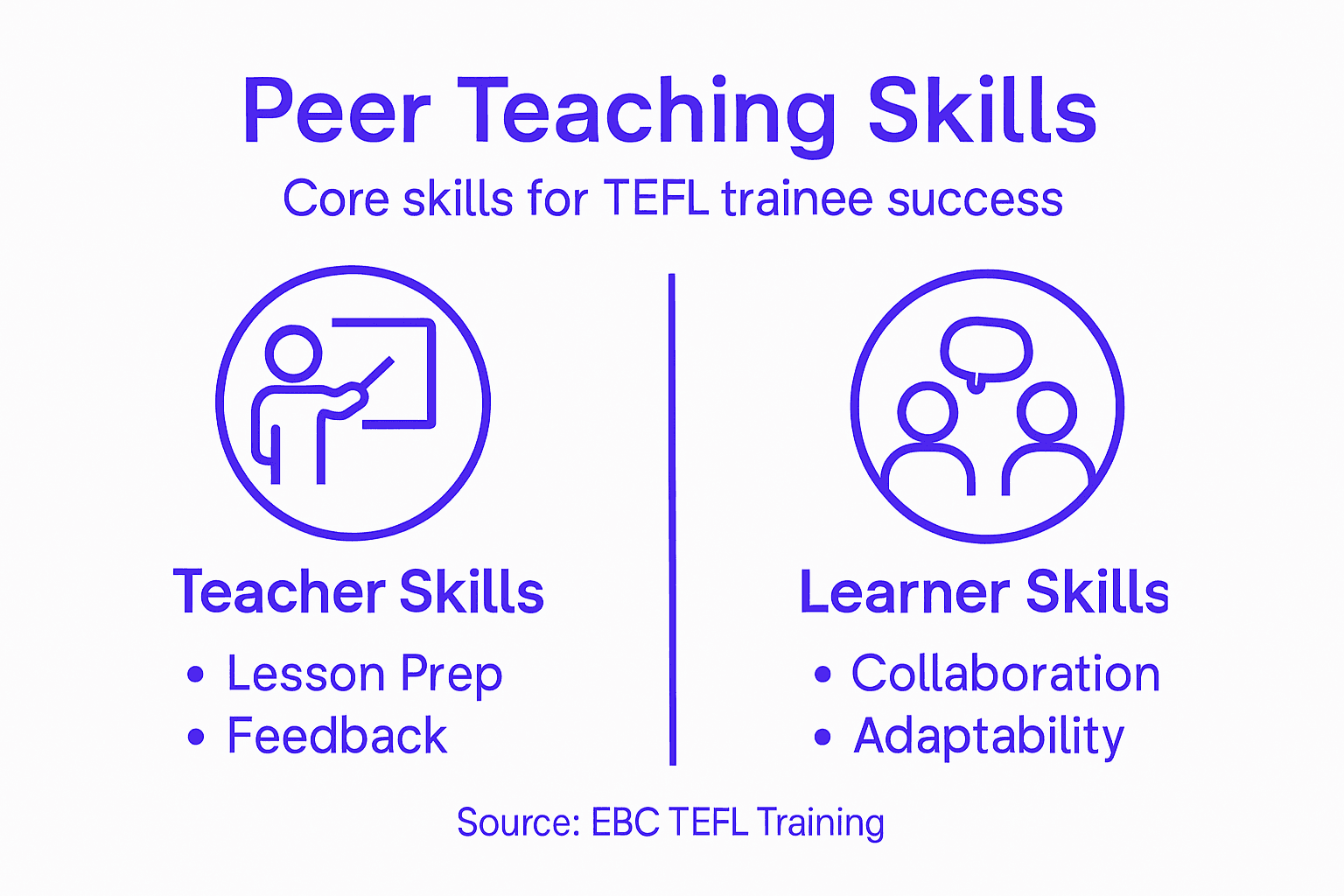
Self-efficacy plays a pivotal role in peer teaching success. Participants must cultivate confidence in their abilities, demonstrate resilience when facing challenges, and maintain a growth mindset that embraces continuous learning and improvement.
The following table summarises key skills required for effective peer teaching in TEFL:
| Skill | Description | Impact on Learning |
|---|---|---|
| Communication Clarity | Explains ideas clearly | Reduces misunderstandings |
| Active Listening | Attentive to peer input | Increases engagement |
| Constructive Feedback | Offers helpful suggestions | Fosters improvement |
| Adaptability | Changes methods as needed | Addresses diverse needs |
| Emotional Intelligence | Recognises and manages emotions | Maintains group harmony |
| Language Proficiency | Strong command of English | Models accurate usage |
Pro tip: Practice peer teaching skills incrementally, starting with small, structured interactions and gradually expanding your comfort zone and instructional capabilities.
Peer Teaching in EBC’s 1-Year Abroad Programmes
EBC’s one-year abroad programmes integrate peer teaching as a transformative learning approach, designed to provide comprehensive language education and professional development. Study abroad experiences offer TEFL trainees unique opportunities to develop advanced teaching skills through collaborative learning methodologies.
Key components of the peer teaching model in EBC’s programmes include:
- Structured Interaction Sessions: Planned peer teaching exchanges
- Cultural Immersion Workshops: Language practice with international peers
- Reflective Practice Modules: Critical analysis of teaching experiences
- Mentorship Integration: Support from experienced language educators
- Cross-Cultural Communication Training: Developing global teaching perspectives
- Practical Teaching Placements: Real-world language instruction opportunities
Programme Design emphasises holistic skill development through carefully curated peer teaching experiences. Trainees engage in systematic learning environments that challenge traditional educational boundaries, enabling them to develop professional competencies beyond traditional classroom settings.
The international context of EBC’s programmes provides an additional layer of complexity and richness to peer teaching interactions. Participants from diverse linguistic and cultural backgrounds collaborate, creating dynamic learning ecosystems that enhance language acquisition and teaching capabilities.
Pro tip: Approach your one-year abroad programme with an open mind, actively seeking opportunities to learn from and teach your international peers.
Unlock Your Potential with Peer Teaching and EBC’s Accredited TEFL Programmes
The article highlights the power of peer teaching as an innovative way for TEFL trainees to develop essential communication, instructional, and cultural skills while immersing themselves in collaborative learning. If you are eager to overcome challenges like gaining teaching confidence, mastering classroom interaction, and building professional experience, EBC’s internationally accredited Trinity College London courses offer the perfect pathway. Our programmes integrate practical peer teaching methodologies with comprehensive teacher training, empowering you to succeed in diverse global classrooms.
Take the next step towards a rewarding English teaching career abroad and join EBC’s unique 1-year study and work programmes in Spain, France, and Italy. Enjoy a rich blend of accredited TEFL certification, language study, cultural immersion, and ongoing global job placement support with free lifetime assistance. Explore how peer teaching can elevate your skills through EBC’s Trinity CertTESOL and specialised courses. Don’t wait to transform your teaching journey—book a consultation today and start empowering yourself to teach English anywhere in the world.
Frequently Asked Questions
What is peer teaching in TEFL?
Peer teaching in TEFL is an instructional approach where trainee teachers collaboratively teach each other, enhancing their language skills and teaching competencies through structured peer-led activities.
How does peer teaching benefit TEFL trainees?
Peer teaching provides numerous benefits, including improved communication abilities, deeper understanding of language concepts, increased self-confidence, and practical teaching experience, making it a valuable method for professional development.
What are the key components of peer teaching in EBC’s programmes?
Key components include structured interaction sessions, cultural immersion workshops, reflective practice modules, mentorship integration, cross-cultural communication training, and practical teaching placements, all designed to enhance the learning experience of TEFL trainees.
What essential skills are required for successful peer teaching?
Successful peer teaching requires skills such as communication clarity, active listening, effective feedback, adaptability, emotional intelligence, and a solid command of the English language, which all play a crucial role in promoting an effective learning environment.