
Over one billion people worldwide are learning English, yet the journey is often misunderstood. Whether you are seeking new opportunities or looking to connect across cultures, understanding what ESL truly stands for is crucial. Discover why the term holds real impact for non-native English speakers and how it shapes classroom experiences and global careers for british learners and educators alike.
Table of Contents
- What Does ESL Stand For And Mean?
- ESL Versus EFL: Core Differences Explained
- Common Contexts And Classroom Applications
- Who Needs ESL Qualifications And Why
- Global Job Opportunities For ESL Teachers
Key Takeaways
| Point | Details |
|---|---|
| Understanding ESL | ESL stands for English as a Second Language, focusing on non-native speakers in English-speaking environments to develop language skills. |
| ESL vs EFL | ESL learners are immersed in English-speaking contexts, while EFL learners study English in non-English speaking countries, leading to different pedagogical approaches. |
| Importance of ESL Qualifications | ESL qualifications are essential for educators and professionals working with non-native speakers, ensuring effective language and cultural integration. |
| Global Job Opportunities | ESL teaching offers diverse job prospects worldwide, from traditional classrooms to corporate training environments and online platforms. |
What Does ESL Stand For And Mean?
ESL is an acronym that stands for English as a Second Language, a term used to describe educational programs designed for non-native English speakers. Unlike other language learning approaches, ESL specifically focuses on individuals residing in English-speaking environments who are working to develop comprehensive language skills.
The term encompasses structured language instruction aimed at helping learners develop reading, writing, listening, and speaking capabilities in English. ESL programs are typically tailored to support students who need to integrate linguistic skills for academic, professional, or personal communication purposes. These comprehensive learning pathways recognise that language acquisition involves more than memorising vocabulary – it requires understanding cultural context, grammatical structures, and practical communication strategies.
Modern ESL instruction goes beyond traditional classroom settings, incorporating diverse learning methodologies. Educators use interactive techniques to help English-language learners develop proficiency, including multimedia resources, conversational practice, immersive experiences, and technology-enhanced learning platforms. This holistic approach ensures that students not only learn linguistic skills but also gain confidence in real-world communication scenarios across academic, professional, and social environments.
ESL Versus EFL: Core Differences Explained
English as a Second Language (ESL) and English as a Foreign Language (EFL) represent two distinct language learning contexts with significant pedagogical differences. Classroom environments and learning approaches vary considerably between these two language acquisition methodologies, reflecting the unique challenges and opportunities presented by each setting.
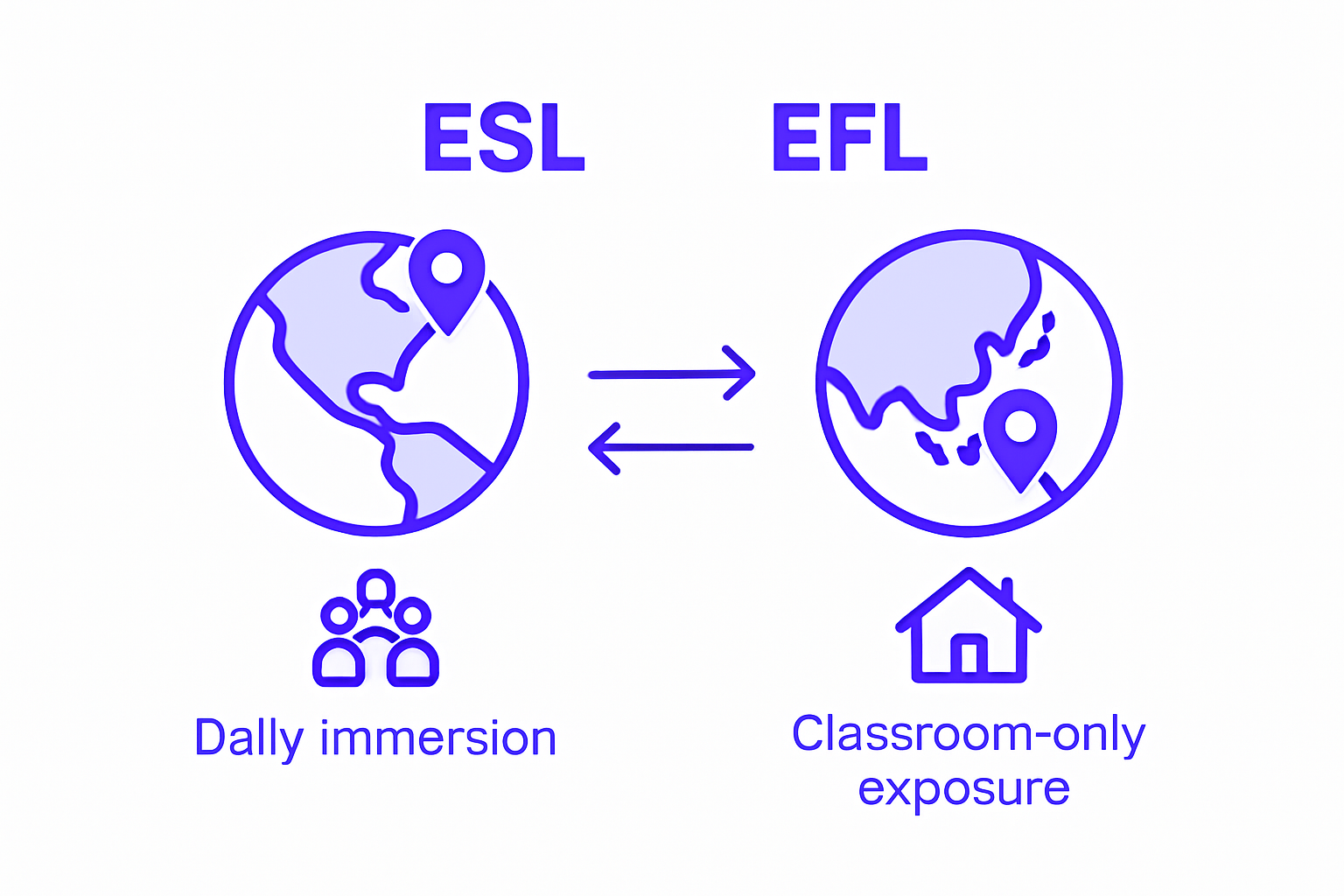
In ESL contexts, learners are typically located in English-speaking countries, surrounded by native speakers and opportunities for immediate linguistic immersion. This environment enables students to practise English daily through real-world interactions, work environments, social settings, and academic institutions. Conversely, EFL learners study English in non-English speaking countries, where opportunities for natural language practice are more limited and primarily confined to classroom interactions.
The core distinctions extend beyond geographical location, encompassing motivation, learning strategies, and linguistic exposure. EFL students often require more structured, intentional language learning approaches, whereas ESL learners can leverage immediate environmental interactions to enhance their language skills. These fundamental differences mean that teaching methodologies, curriculum design, and assessment strategies must be carefully tailored to address the specific contextual challenges of each language learning environment.
Practically speaking, an ESL student in London might learn English through daily conversations, workplace interactions, and academic seminars, while an EFL student in Japan would primarily develop language skills through targeted classroom instruction, digital resources, and structured language exchanges. These varied contexts demand flexible, nuanced approaches to language education that recognise the unique challenges and opportunities inherent in each learning pathway.
Common Contexts And Classroom Applications
Language educators employ diverse teaching methodologies across ESL and EFL settings, recognising that contextual differences demand nuanced instructional approaches. Comparative studies of teaching strategies reveal significant variations in reading comprehension and language awareness techniques, underscoring the importance of adaptive pedagogical methods.
In ESL classrooms, instructional strategies prioritise immediate, practical communication skills. Students engage in immersive learning experiences that integrate real-world language use, focusing on conversational fluency, cultural understanding, and contextual communication. These environments often utilise task-based learning, role-playing exercises, and interactive discussions that mirror authentic social interactions encountered in English-speaking societies.

Comparative analyses of language learning strategies demonstrate the critical need for tailored educational approaches across different linguistic contexts. EFL classrooms typically rely more heavily on structured grammatical instruction, systematic vocabulary development, and carefully designed linguistic frameworks. These settings often incorporate multimedia resources, digital language labs, and structured linguistic exercises to compensate for limited natural language exposure.
Practical classroom applications vary significantly between ESL and EFL environments. An ESL classroom in Australia might focus on idiomatic expressions, workplace communication, and cultural nuances, while an EFL classroom in South Korea would emphasise precise grammatical structures, standardised test preparation, and systematic language skill development. These contextual differences highlight the critical importance of recognising and adapting to the unique linguistic learning environments encountered by English language educators worldwide.
Who Needs ESL Qualifications And Why
ESL qualifications are essential for educators, administrators, and professionals working with non-native English speakers across diverse educational and professional environments. Specialised training ensures teachers can effectively address the unique challenges faced by English-language learners, providing critical support for linguistic and cultural integration.
Multiple professional groups require ESL qualifications, including classroom teachers, corporate language trainers, immigration support specialists, and educational administrators. School systems in English-speaking countries typically mandate ESL certifications for educators working with multilingual student populations. These qualifications demonstrate a comprehensive understanding of language acquisition theories, culturally responsive teaching strategies, and adaptive instructional techniques designed to support diverse learner needs.
Educators working with English-language learners must develop sophisticated understanding of linguistic and cultural dynamics, extending beyond traditional language instruction. Professionals with ESL qualifications can work in varied settings, including public and private schools, international corporations, language centres, online teaching platforms, refugee support organisations, and community education programmes. These credentials validate an individual’s expertise in creating inclusive, supportive learning environments that facilitate effective language development.
Beyond traditional academic settings, ESL qualifications open doors to international career opportunities. Professionals with these credentials can teach abroad, work with multinational corporations, support immigrant integration programmes, develop educational resources, and provide specialised language training across government, non-profit, and private sector organisations. The versatility of ESL qualifications reflects the growing global demand for sophisticated language education professionals who can bridge linguistic and cultural boundaries.
Global Job Opportunities For ESL Teachers
ESL teaching represents a dynamic global career pathway with opportunities spanning multiple continents and professional sectors. The worldwide demand for English language educators continues to expand across diverse international contexts, offering professionals unprecedented professional mobility and cultural exchange experiences.
Regional job markets present distinctive opportunities for ESL teachers. In Asia, countries like Japan, South Korea, China, and Vietnam offer competitive salaries and comprehensive employment packages. Middle Eastern nations such as the United Arab Emirates, Saudi Arabia, and Qatar provide lucrative contracts with tax-free income. European countries including Spain, Italy, and France consistently seek qualified English language instructors for public and private educational institutions, language centres, and corporate training programmes.
Understanding nuanced learning strategies dramatically enhances an educator’s global employability, allowing teachers to adapt seamlessly across different cultural and educational environments. Online platforms have further revolutionised ESL employment, creating opportunities for remote teaching, digital curriculum development, and international language consultation that transcend traditional geographical limitations.
Beyond traditional classroom settings, ESL qualifications open diverse career pathways. Professionals can work in international corporations, diplomatic missions, refugee support organisations, educational technology companies, and multimedia content development. The versatility of ESL expertise means teachers are no longer confined to traditional educational roles but can explore innovative professional landscapes that leverage linguistic and intercultural communication skills.
Elevate Your ESL Teaching Career with Accredited Training and Global Opportunities
Understanding what ESL means and why it matters is crucial for aspiring English teachers seeking to make a real impact. The challenges of teaching English as a Second Language require not only language proficiency but also specialised skills in cultural integration, communication strategies, and practical classroom experience. At EBC TEFL, we provide Trinity College London accredited teacher training programmes that empower you to address these challenges effectively. Our courses include practical, hands-on methodologies designed to help you succeed in diverse ESL teaching contexts worldwide.
If you are ready to turn your passion for teaching into a fulfilling global career, explore our comprehensive offerings. From the prestigious Trinity CertTESOL and specialist courses like Business English and Online Teaching to our unique 1-year study and work abroad programmes in Spain, France, and Italy, we offer unmatched support. These programmes combine accredited teacher certification, immersive language study, visa assistance, and part-time teaching opportunities, allowing you to develop professionally while embracing new cultures.
Start your journey today with free expert consultations and personalised guidance designed specifically for those passionate about ESL education. Join our supportive community and benefit from lifetime job placement assistance across global teaching markets. Don’t miss this opportunity to transform your teaching ambitions into a rewarding international career. Learn more and book a call now at EBC TEFL.
Frequently Asked Questions
What does ESL stand for and why is it important?
ESL stands for ‘English as a Second Language’. It is important because it provides non-native speakers with structured language instruction, helping them develop essential skills for effective communication in English-speaking environments.
What are the main differences between ESL and EFL?
ESL focuses on teaching English in English-speaking countries, where students can practise daily with native speakers, while EFL refers to teaching English in non-English speaking countries, where opportunities for practice are typically limited to classroom interactions.
Who needs ESL qualifications and what do they entail?
ESL qualifications are essential for educators, corporate trainers, and professionals working with non-native English speakers. These qualifications ensure teachers have a solid understanding of language acquisition theories, culturally responsive teaching strategies, and effective instructional techniques tailored to diverse learners.
What career opportunities are available for ESL teachers?
ESL teachers can find career opportunities in a variety of sectors, including public and private schools, language centres, international corporations, and community education programmes. With the rise of online platforms, remote teaching and curriculum development have also become viable options.
Recommended
- TEFL Blog: Teaching Tips, Stories & Career Advice | EBC
- Why is English important? – EBC Trinity CertTESOL and TEFL courses
- English language teaching skills for successful TEFL teachers – EBC Trinity CertTESOL and TEFL courses
- TESOL, TEFL, CELTA, DELTA, TESL – How Are They Different? – EBC Trinity CertTESOL and TEFL courses
